Observational_Cosmology_MOC
Observational Cosmology - Map of Content
A.Y. 2024/2025, Prof. Giulia Rodighiero and Prof. Paolo Cassata, with visiting professor Pablo Pérez-González and a special lecture on lensing by Dr. Andrea Enia.
The central thread of this course is a different question from the high-energy lab, instead of how do we detect the most violent objects, here it is:
- how do we measure the universe itself, and everything inside it, from inside it?
Every topic connects to this chain: \(\text{distant source} \to \text{cosmological redshift} \to \text{expanding geometry} \to \text{distance ladder} \to \text{observable (flux, size, spectrum)} \to \text{cosmological parameters}\)
Every observation we make is contaminated by the universe we are trying to measure. The K-correction, the angular-diameter turnover, the surface-brightness $(1+z)^{-4}$ penalty, all of them are the universe leaving fingerprints on its own photons.
Timetable and lecturers
- 24 Feb - 24 Mar - G. Rodighiero (Chapters 0-1: Friedmann universe, large-scale structure)
- 31 Mar - 3 Apr - P. Pérez-González (visiting, galaxy studies / high-z observations - see below)
- 7-8 Apr - A. Enia (special lectures on gravitational lensing)
- 14 Apr - 26 May - P. Cassata (thermal history, CMB, primordial universe, perturbations, structure formation)
Note: in the original syllabus topic 7 (“Primordial Universe, Big Bang, phase transitions, cosmological inflation”) was struck through and replaced by “Detection techniques for protoclusters”, and a red frame surrounds topics 9-10 (post-recombination IGM and galaxy formation/evolution). This is the part tied directly to JWST and to Pablo’s visit.
Block 0 - The homogeneous Friedmann universe
This is the mathematical spine that everything later hangs off of. Before any real object enters the course, we set the stage: a metric, a scale factor, a redshift, a handful of density parameters.
- [[Cosmological principle]] - homogeneous + isotropic at a given cosmic time, “fundamental observer”
- [[Hubble law]] - $\vec{v} = H_0 \vec{d}$, recession proportional to distance, scale factor $R(t)$
- [[Robertson-Walker metric]] - $ds^2 = dt^2 - \frac{a^2(t)}{c^2}\left[\frac{dr^2}{1-kr^2} + r^2(d\vartheta^2 + \sin^2\vartheta\, d\varphi^2)\right]$, $a(t) \equiv R(t)/R_0$
- [[Curvature parameter k]] - $k=0$ flat, $k=+1$ closed spherical, $k=-1$ open hyperbolic
-
[[Comoving vs proper coordinates]] - $d = a(t) \cdot r$, $H_0 = \dot{a}/a _{t_0} \simeq 70$ km/s/Mpc - [[Cosmological redshift]] - $(1+z) = a(t_e)^{-1} = \nu_e/\nu_0$, redshift is the ratio of scale factors between emission and reception
- [[Newtonian derivation of Friedmann]] - shell argument, $\ddot{a} = -\frac{4\pi}{3}G\rho_0 a^{-2}$, energy-conservation integral gives $\dot{a}^2 = \frac{8\pi G\rho_0}{3}a^{-1} - kc^2$
- [[Friedmann solutions]] - Milne vacuum ($R\propto t$), Einstein-de Sitter ($a\propto t^{2/3}$), open, closed
- [[GR Friedmann with Lambda|GR Friedmann with Λ]] - Einstein field eqs. $R_{ik} - \tfrac{1}{2}g_{ik}R - g_{ik}\Lambda = \frac{8\pi G}{c^4}T_{ik}$, $T_{ik}$ perfect fluid, $\Lambda$ as vacuum energy $\rho_V$
- [[Density parameters]] - $\Omega_m, \Omega_\Lambda, \Omega_\gamma, \Omega_k$, critical density $\rho_c = 3H_0^2/8\pi G$
- [[Matter vs radiation density scaling]] - $\rho_m \propto a^{-3}$, $\rho_\gamma \propto a^{-4}$, equivalence at $z \sim 3330$, $t \sim 53{,}000$ yr
- [[Curvature-dynamics relation]] - $c^2 k = H_0^2[\Omega_m + \Omega_\Lambda - 1]$, flat iff $\sum\Omega = 1$
-
[[Deceleration parameter]] - $q_0 \equiv -\ddot{a}a/\dot{a}^2 {t_0} = \Omega_m/2 - \Omega\Lambda$ - [[Time-redshift relation]] - $dt = -\frac{dz}{H_0(1+z)}[(1+z)^2(\Omega_m z + 1) - z\Omega_\Lambda(2+z)]^{-1/2}$
- [[Cosmic look-back time]] - integral out to $z$, extrapolation to $z\to\infty$ gives $t_0 \approx 13.7$ Gyr
Block 1 - Distances in cosmology
Four distances, all equal at low $z$, all different at high $z$. This is where observational cosmology stops being linear algebra and becomes the art of comparing apples to apples across billions of years.
- [[Radial comoving distance]] - $d_M = r(z) = \frac{c}{H_0}\int_0^z [\Omega_m(1+z’)^3 + \Omega_\Lambda]^{-1/2}\, dz’$ (flat)
- [[Angular diameter distance]] - $d_A = D/d\vartheta = d_M/(1+z)$, non-monotonic, turns over around $z \sim 1.5$
- [[Luminosity distance]] - $d_L = r(1+z) = d_M(1+z) = d_A(1+z)^2$, two $(1+z)$ factors from photon-energy loss and photon-arrival-rate dilation
- [[Surface brightness dimming]] - $\sigma \propto d_A^2/d_L^2 \propto (1+z)^{-4}$, the brutal penalty on high-$z$ imaging
- [[K-correction]] - the translation between what the source emits at $\nu_e = \nu_0(1+z)$ and what our filter sees at $\nu_0$, magnitudes become $m = M + 5\log d_{L,\text{Mpc}} + 25 + K(z)$
- [[K-correction in optical vs sub-mm]] - in the optical $K(z) > 0$, galaxies look fainter, in sub-mm $K(z) < 0$ because we climb the dust bump, so 850 μm sources stay roughly constant flux from $z\sim1$ to $z\sim10$ (the sub-mm is a window onto the high-$z$ universe)
- [[Supernova Hubble diagram]] - Perlmutter, Riess, Schmidt, SN Ia Type Ia standard candles at $z \sim 0.5$ to $1$ are fainter than an empty or matter-only universe predicts → need $\Lambda$, best fit $\Omega_M \approx 0.27$, $\Omega_\Lambda \approx 0.73$
Block 2 - The standard model - ΛCDM
The current best numbers: \(H_0 \simeq 70~\text{km/s/Mpc}, \quad \Omega_m \simeq 0.3, \quad \Omega_\Lambda \simeq 0.7, \quad \Omega_\gamma \simeq 10^{-3}\)
Three regimes in $a(t)$:
- Radiation-dominated until $z \sim 3000$: $a(t) \propto t^{1/2}$
- Matter-dominated from recombination until $z \sim 0.7$: $a(t) \propto t^{2/3}$
-
Λ-dominated from $z \sim 0.7$ onward: $a(t) \propto \exp(\sqrt{\Lambda/3}\, t)$
- [[ΛCDM current parameters]]
- [[Transition epochs]] - matter-radiation equivalence, recombination, onset of Λ
- [[Various models of the universe]] - EdS vs open vs standard - they coincide at small $t$, diverge massively at large $t$
Block 3 - Deviations from homogeneity and gravitational lensing (Rodighiero + Enia)
Once the FLRW backdrop is built, we perturb it.
- [[Gravitational lensing - intro]] (Dr. A. Enia, 7-8 April)
- [[Strong vs weak lensing]]
- [[Lensing as a cosmological probe]] - mass mapping, Einstein radius, time delays
Block 4 - Perturbations and peculiar motions (Cassata, later)
- [[Cosmological evolution of perturbations in the cosmic fluid]]
- [[Perturbations in an expanding universe]]
- [[Peculiar velocities of galaxies and structures]]
- [[Jeans analysis in expanding universe]]
- [[Growth factor D(z)]]
Block 5 - Thermal history of the universe (Cassata)
- [[Brief thermal history]] - from Planck era to recombination
- [[Recombination]] - $z \sim 1100$, drop in free-electron fraction
- [[Decoupling]] - photon mean free path → $\infty$, last scattering surface
Block 6 - The Cosmic Microwave Background (Cassata)
- [[CMB - discovery and blackbody spectrum]] - Penzias & Wilson 1965, $T_0 = 2.725$ K
- [[CMB anisotropies]] - dipole, acoustic peaks, $\Delta T/T \sim 10^{-5}$
- [[CMB power spectrum]] - COBE, WMAP, Planck, peaks constrain $\Omega_b h^2$, $\Omega_m h^2$, curvature
- [[Polarization E and B modes]]
Block 7 - Primordial universe (Cassata - replaced in this AY by detection techniques for protoclusters)
- [[Big Bang nucleosynthesis]]
- [[Phase transitions]]
- [[Cosmological inflation]] - Guth, Linde, solves flatness, horizon, monopole problems
- [[Protocluster detection techniques]] - overdensities of Lyα emitters, narrow-band imaging, IR-selected structures, spectroscopic confirmation, the JWST era
Block 8 - Origin and evolution of cosmological structure (Cassata)
- [[Linear vs nonlinear regime]]
- [[Spherical collapse]] - $\delta_c \simeq 1.686$
- [[Press-Schechter formalism]] - halo mass function
- [[N-body simulations]] - Millennium, IllustrisTNG
Block 9 - The post-recombination universe, diffuse baryons, IGM (Cassata)
- [[Reionization]] - $z \sim 6$ to $10$, ionizing photons from first galaxies/quasars
- [[Intergalactic medium]]
- [[Lyman-alpha forest|Lyman-α forest]] - neutral hydrogen along quasar sight lines
- [[Missing baryons]] - WHIM, warm-hot intergalactic medium
Block 10 - Galaxy formation and evolution (Pablo Pérez-González + Cassata)
This block is where observational cosmology touches down into actual galaxies and the data Pablo works on.
Pablo’s lecture series (31 March - 3 April):
Lecture 0 - historical introduction
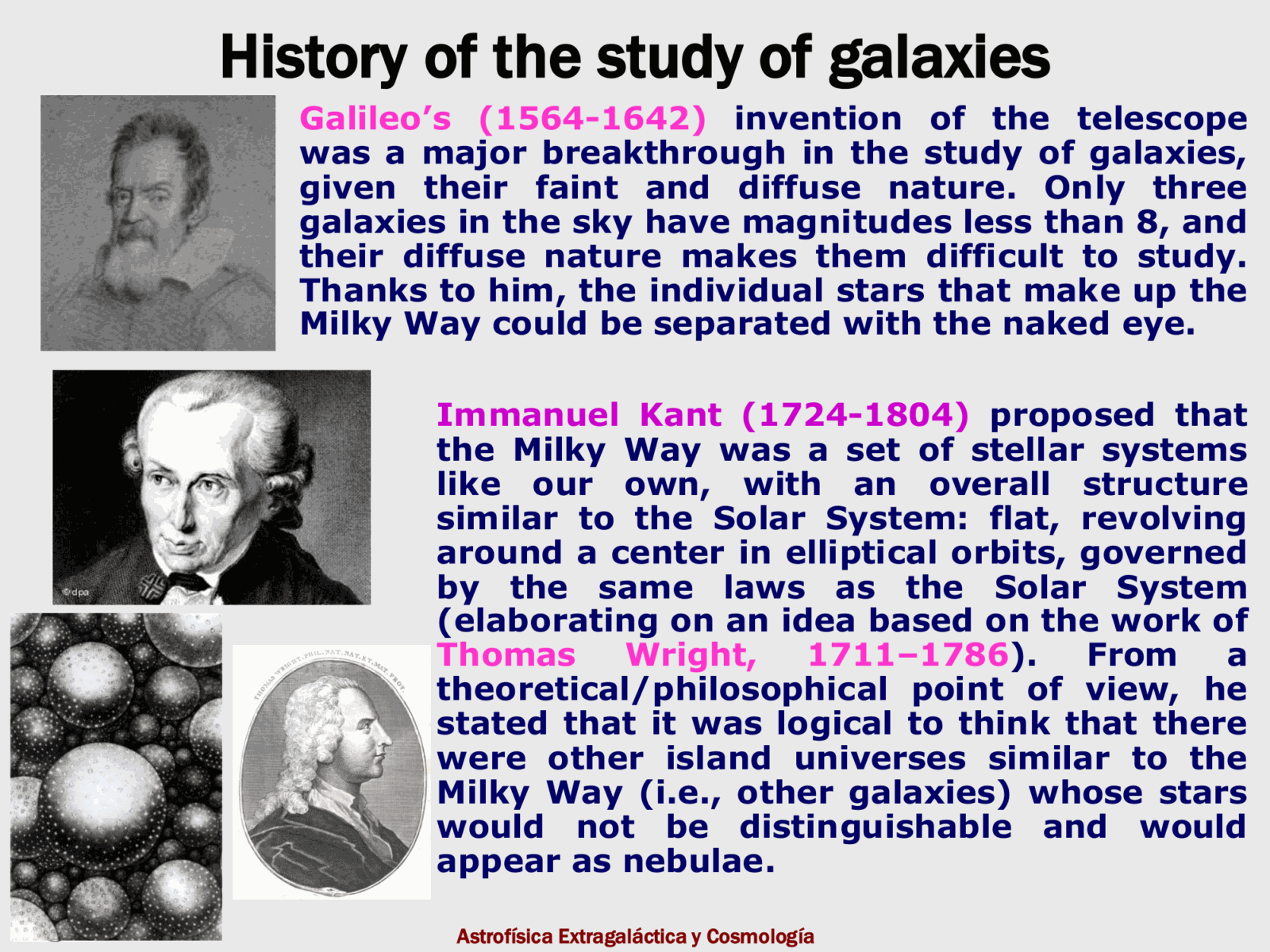
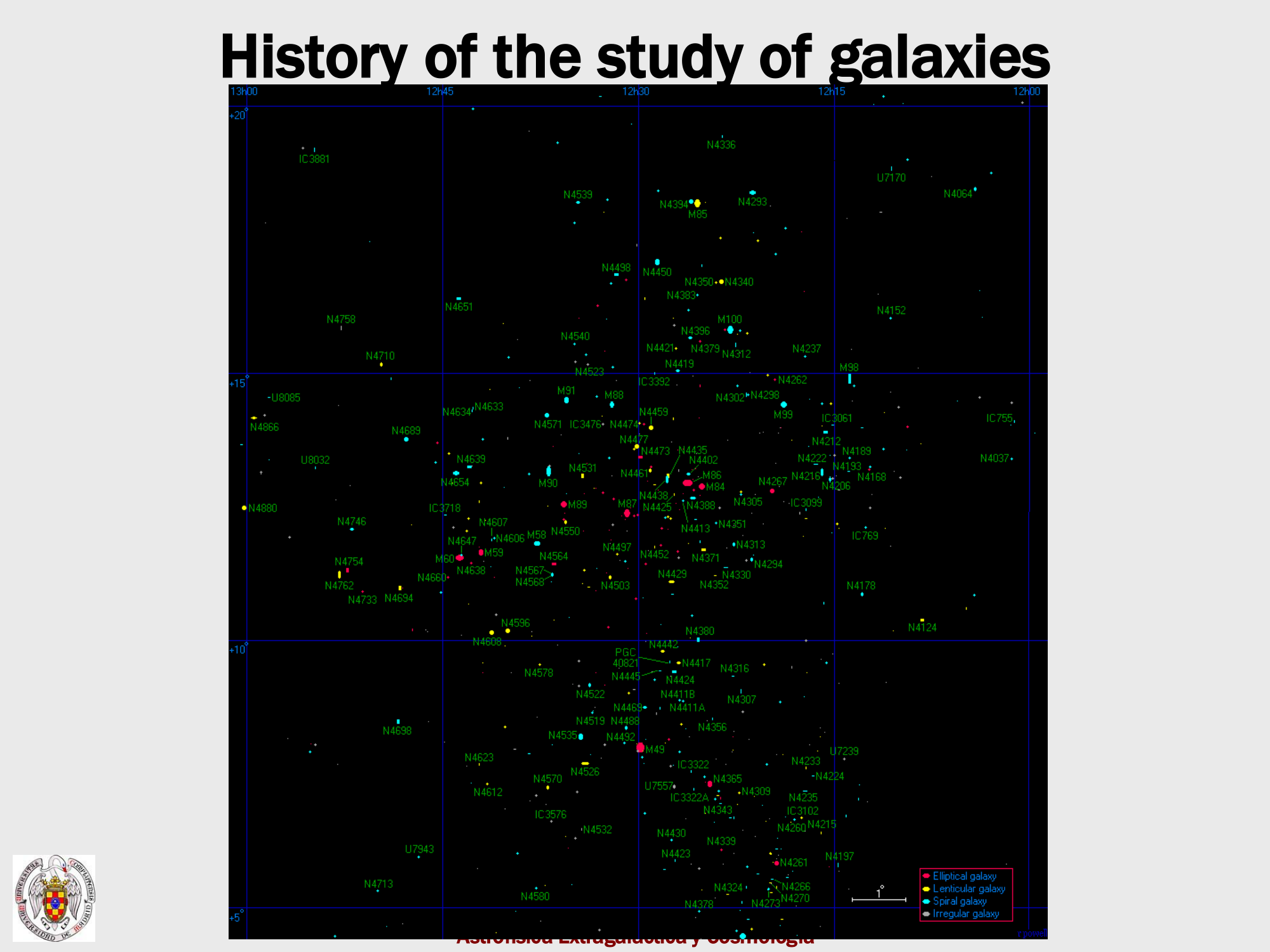
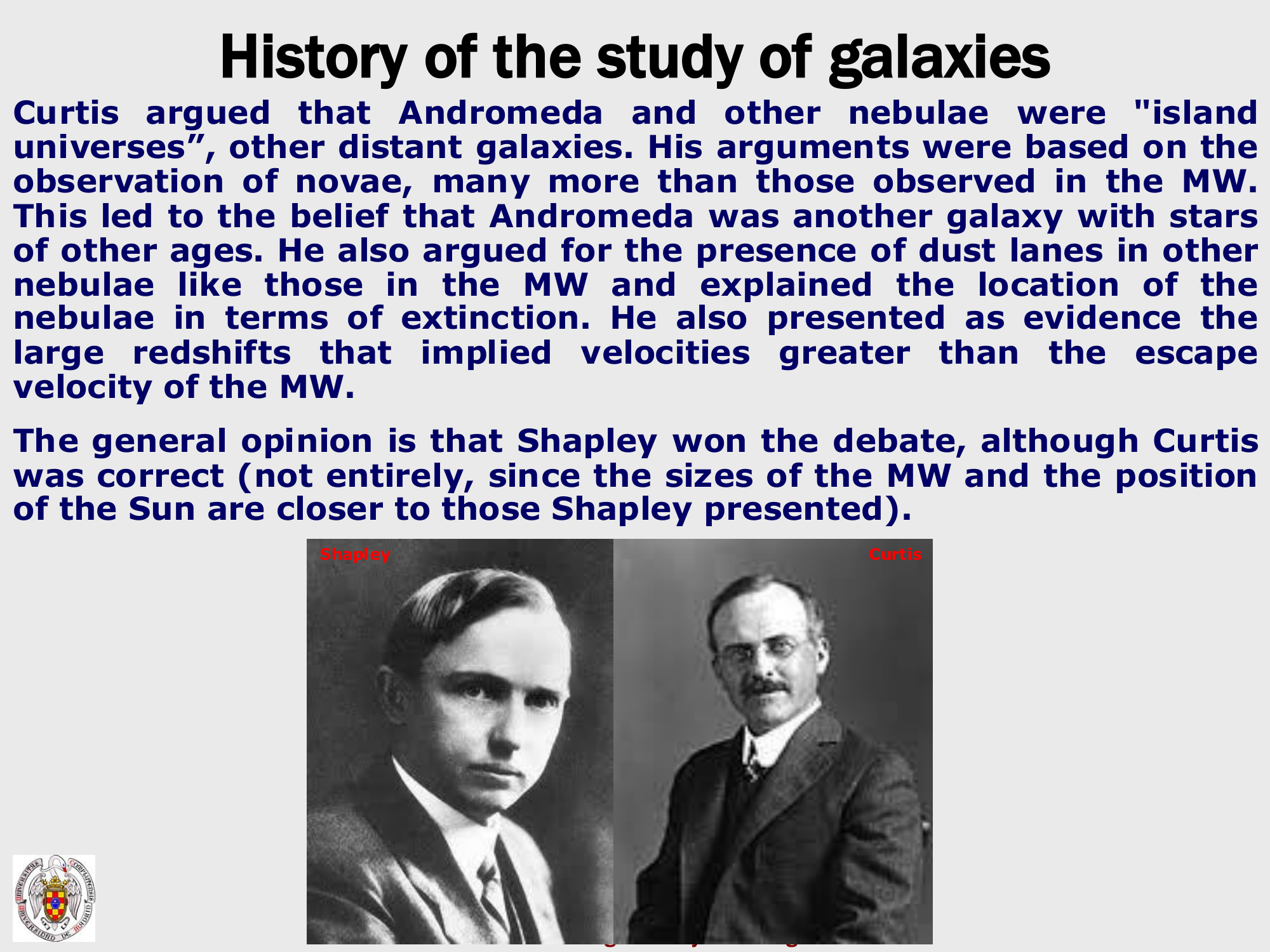
- [[Pablo_01_Introduction_to_galaxy_studies]] - historical arc from Al-Sufi’s “small cloud” to JWST
Lecture 1A - statistical properties of galaxies (lecture overview)
- [[Pablo_02_Statistical_properties_of_galaxies]] - the master overview of this block
Distributions of galaxy parameters
- [[Color bimodality of galaxies]] - Baldry 2004 two peaks in $u-r$
- [[Red sequence and blue cloud]] - passive vs star-forming populations
- [[Green valley and quenching tracks]] - Faber 2007 evolutionary arrows
- [[Galaxy color, density and morphology]] - Hogg 2004, Blanton & Moustakas 2009
Counts
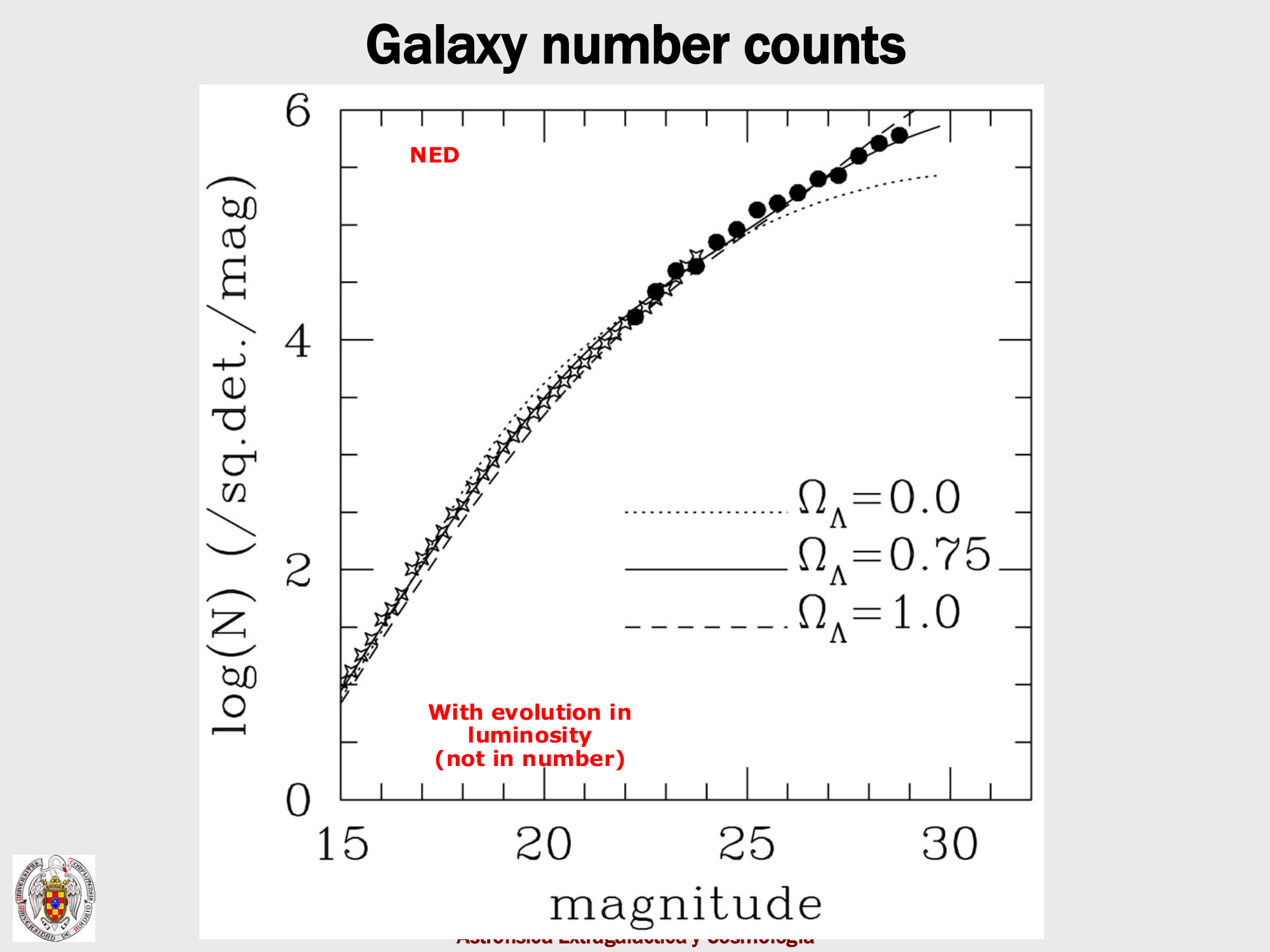
- [[Galaxy number counts N(m)]] - the Euclidean prediction $N(<m) \propto 10^{0.6 m}$
- [[Differential vs cumulative number counts]] - $dN/dm$ vs $N(<m)$, $dN/dS$
- [[Galaxy counts at different wavelengths]] - Durham compilation, optical to sub-mm
- [[Driver 1998 counts by morphology]] - faint blue galaxy excess
Sizes and biases
- [[Galaxy size-luminosity relation]] - $R_e$ vs $M_B$ across galaxy classes
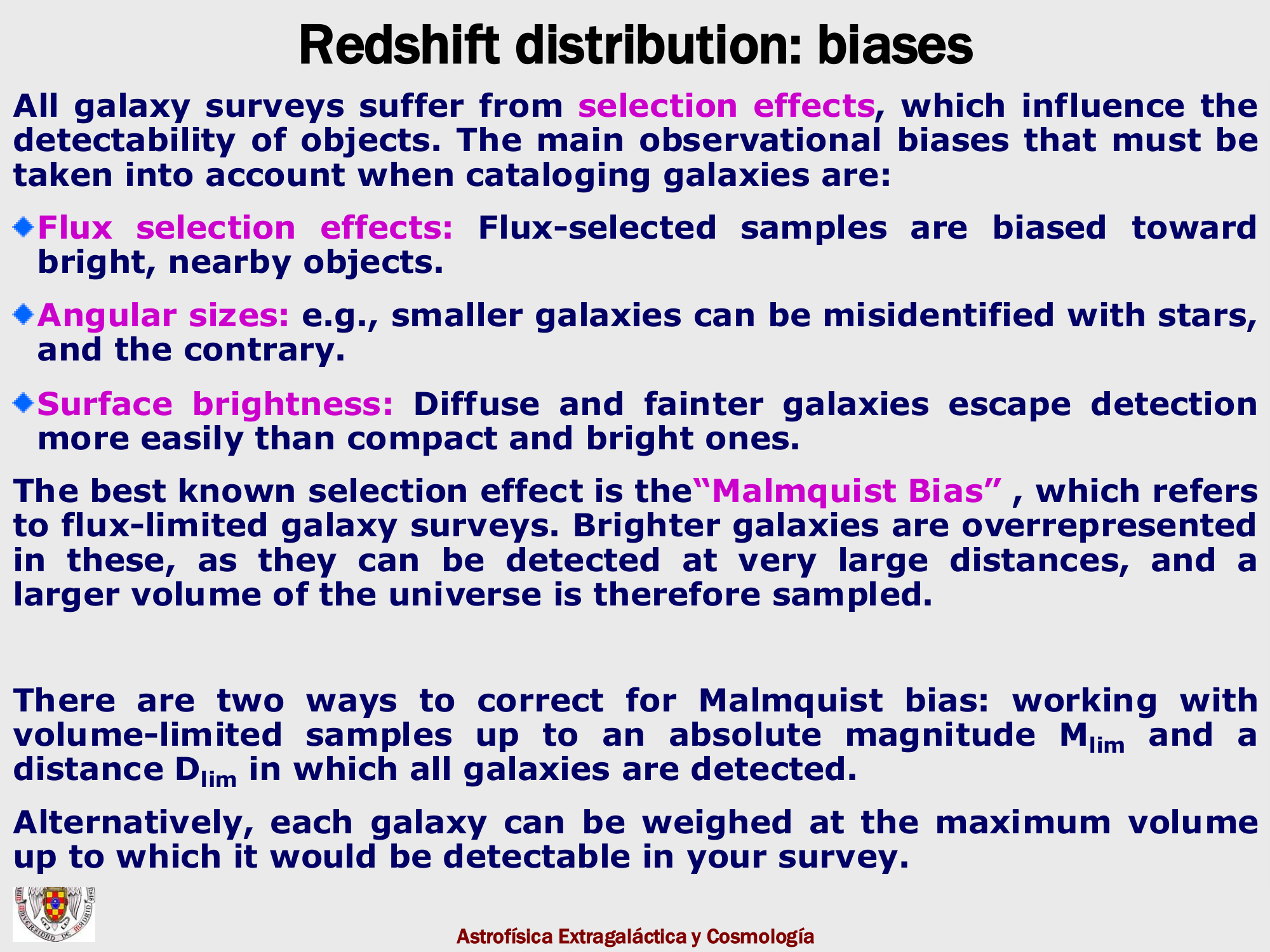
- [[Redshift distribution of flux-limited samples]] - Brinchmann 2008
- [[Malmquist bias]] - flux-limited samples preferentially select luminous sources
- [[Photometric redshifts]] - Benítez 2000 likelihood, 4000 Å break
- [[Photo-z biases and catastrophic outliers]] - Oyaizu 2008, failure modes
Luminosity function
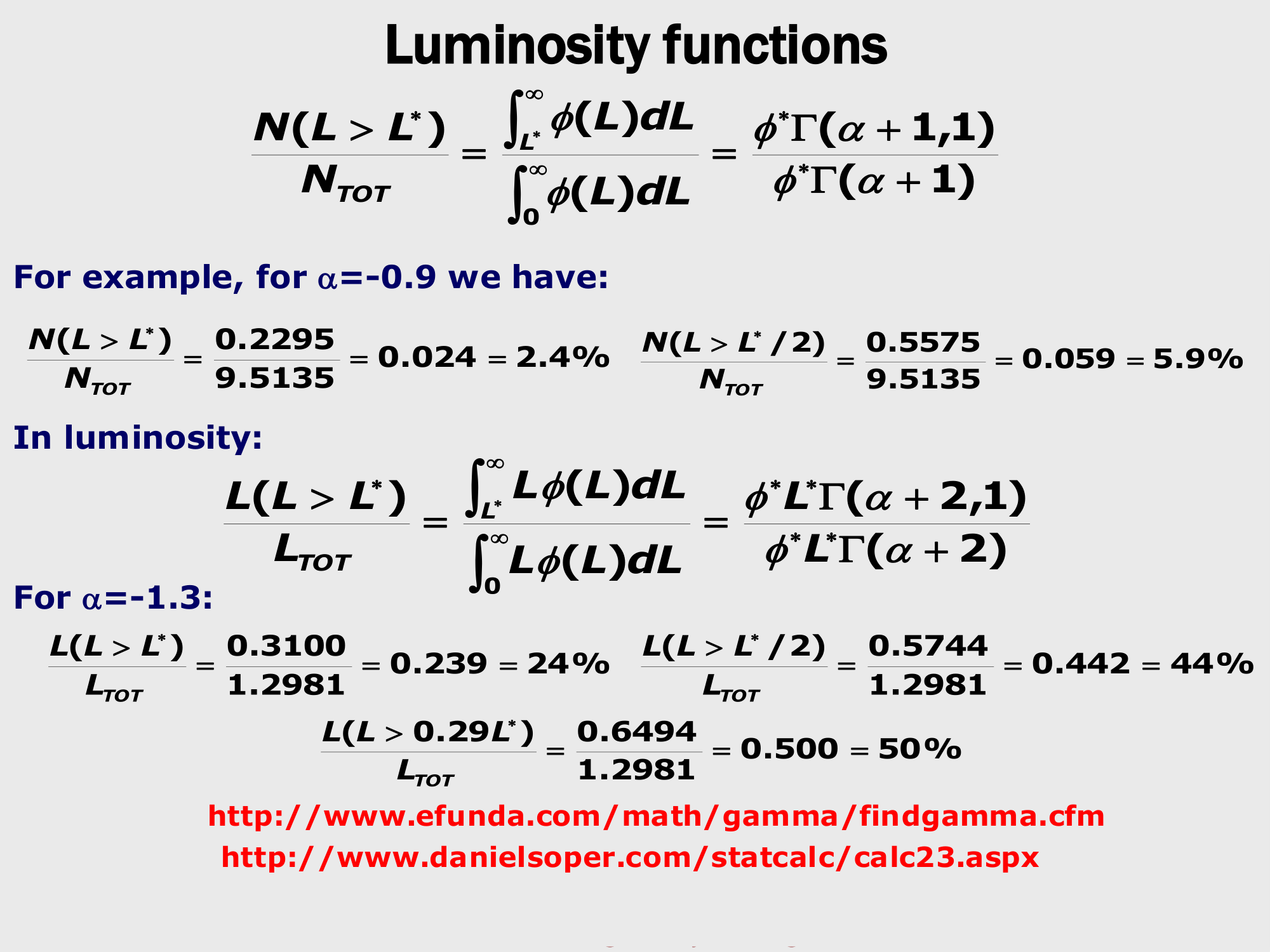
- [[Luminosity function definition]] - $dN = \phi(L)\, dL\, dV$
- [[Schechter function]] - $\phi(L) = (\phi^/L^)(L/L^)^\alpha e^{-L/L^}$
- [[Schechter function in magnitudes]] - the form fit to data
- [[Integrals of the Schechter function]] - number, luminosity, $N(>L^*)$ as Gamma functions
- [[1Vmax estimator]] - Schmidt 1968 non-parametric LF
- [[Schechter K-band luminosity function]] - Smith 2009: $M^=-23.19$, $\alpha=-0.81$, $\phi^=0.0166$
- [[Double power-law modified Schechter]] - Pérez-González 2005 bright-end excess at high $z$
- [[LF by morphology and SED]] - Driver 2006, Wolf 2003
Mass functions and the halo connection
- [[Stellar mass function]] - Cole 2001, Bell 2003, Pérez-González 2008
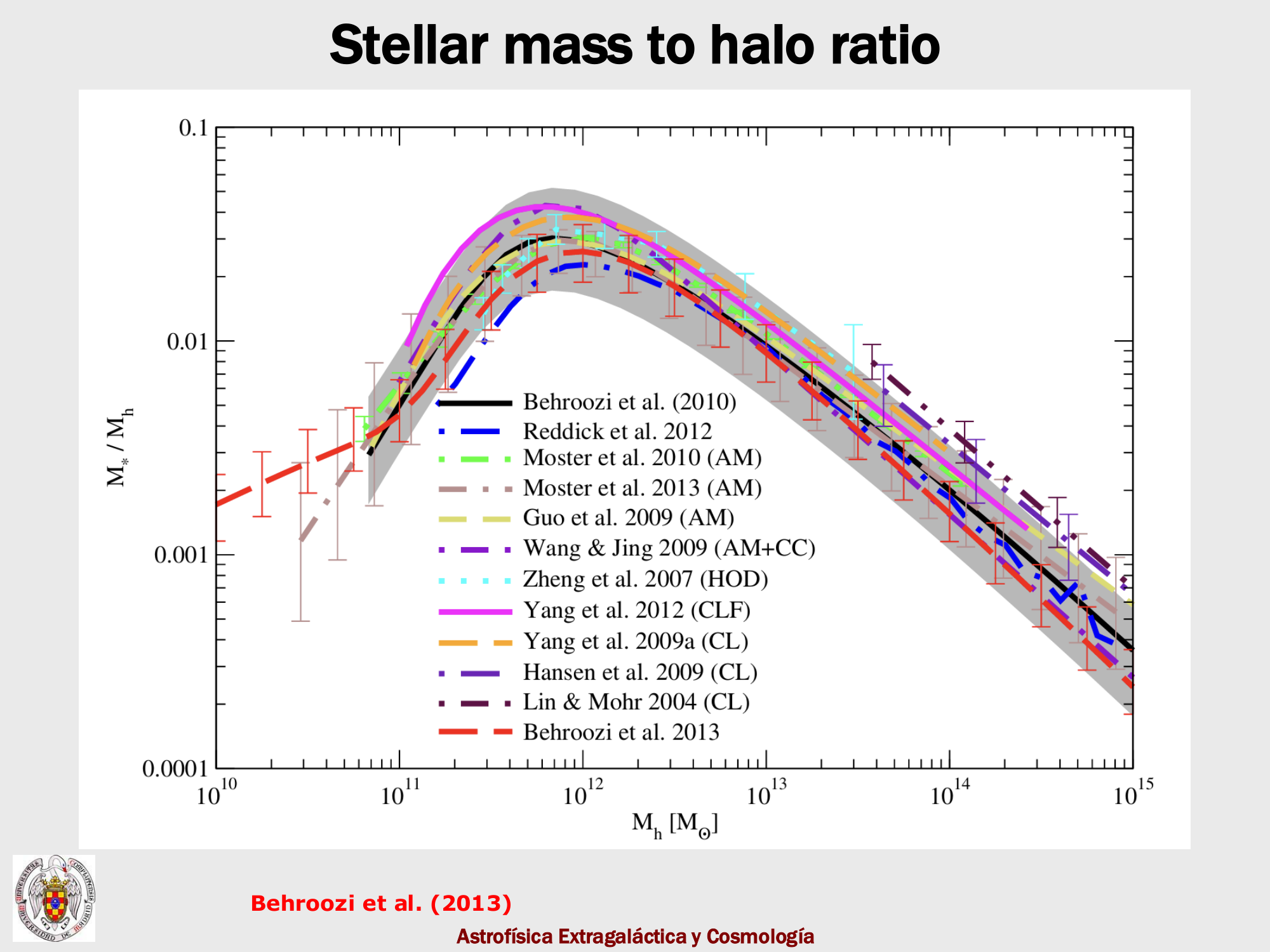
- [[Halo mass function vs galaxy mass function]] - the factor-of-six gap
- [[Halo gravity suppression of galaxy formation]] - SN feedback at low mass, AGN feedback at high mass
- [[Stellar-to-halo mass ratio]] - Behroozi 2013 peak at $M_h \sim 10^{12}\,M_\odot$
Cosmic histories (integrals over $z$)
- [[Cosmic star formation history]] - Madau-Dickinson plot, peak at $z \sim 2$
- [[Cosmic stellar mass density growth]] - Pérez-González 2008a buildup
- [[SFR and stellar mass density connection]] - $\rho_{SFR} = d\rho_*/dt$
Scaling relations
- [[Galaxy main sequence of star formation]] - Rodighiero 2011, Santini 2017
- [[Fundamental plane of ellipticals]] - $R_e \propto \sigma^{1.4} \langle I \rangle_e^{-0.9}$
- [[Tully-Fisher relation]] - $L \propto V_{\text{flat}}^4$
- [[Schmidt-Kennicutt law]] - $\Sigma_{SFR} \propto \Sigma_{\text{gas}}^{1.4}$
- [[Magorrian relation]] - $M_{BH} \approx 10^{-3}\, M_{\text{bulge}}$
Lecture 1B - star formation in galaxies
- [[Pablo_03_Star_formation_in_galaxies]] - the master overview of this block
Definitions and time scales
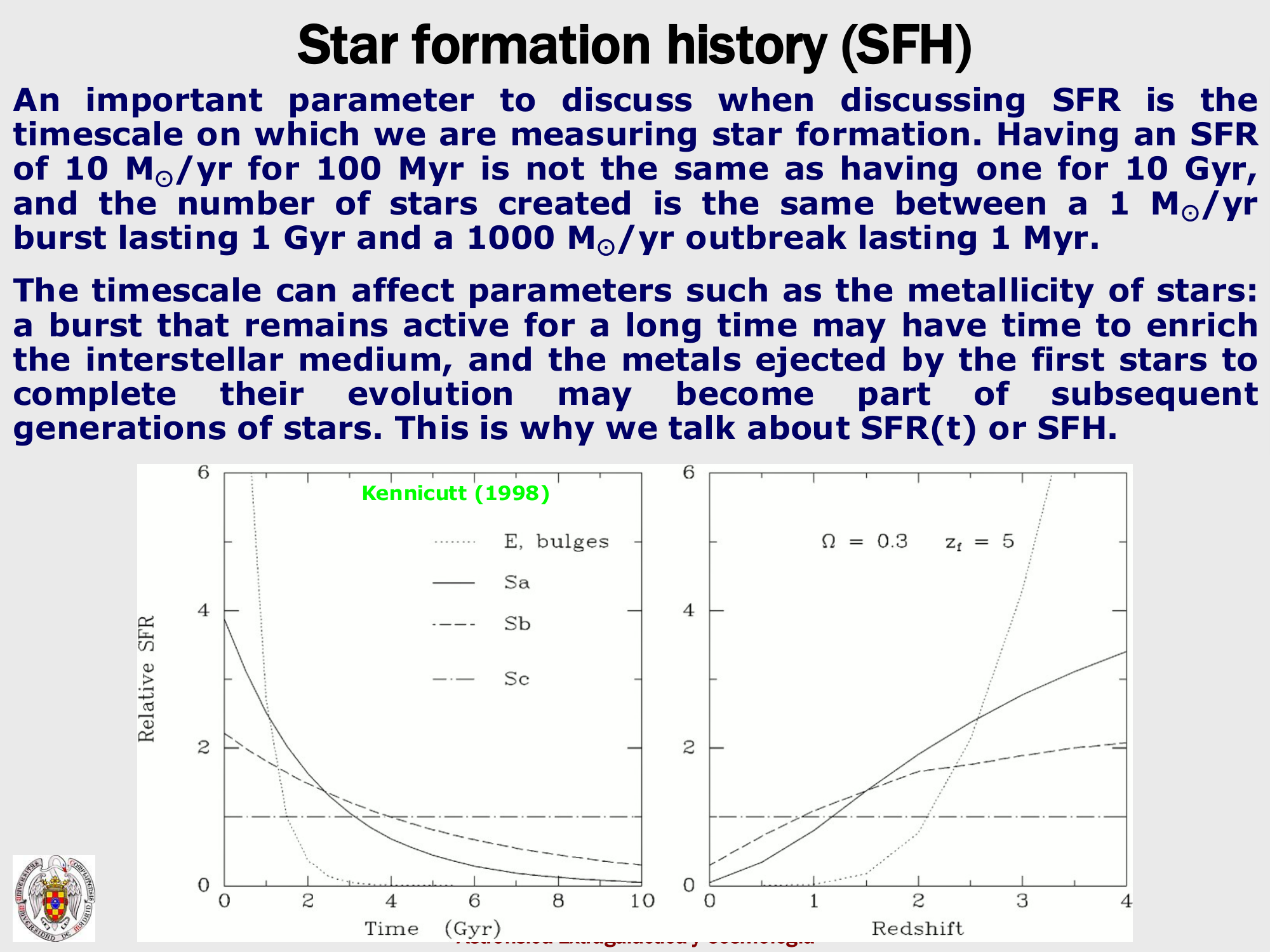
- [[Star formation rate and sSFR]] - $\psi = dM_*/dt$, sSFR as doubling-time inverse
- [[Star formation history parametrizations]] - SSP, CON, τ, delayed, non-parametric
- [[Galaxy time scales]] - Hubble, dynamical $\sqrt{3\pi/16 G\rho}$, cooling, SF, enrichment, merger
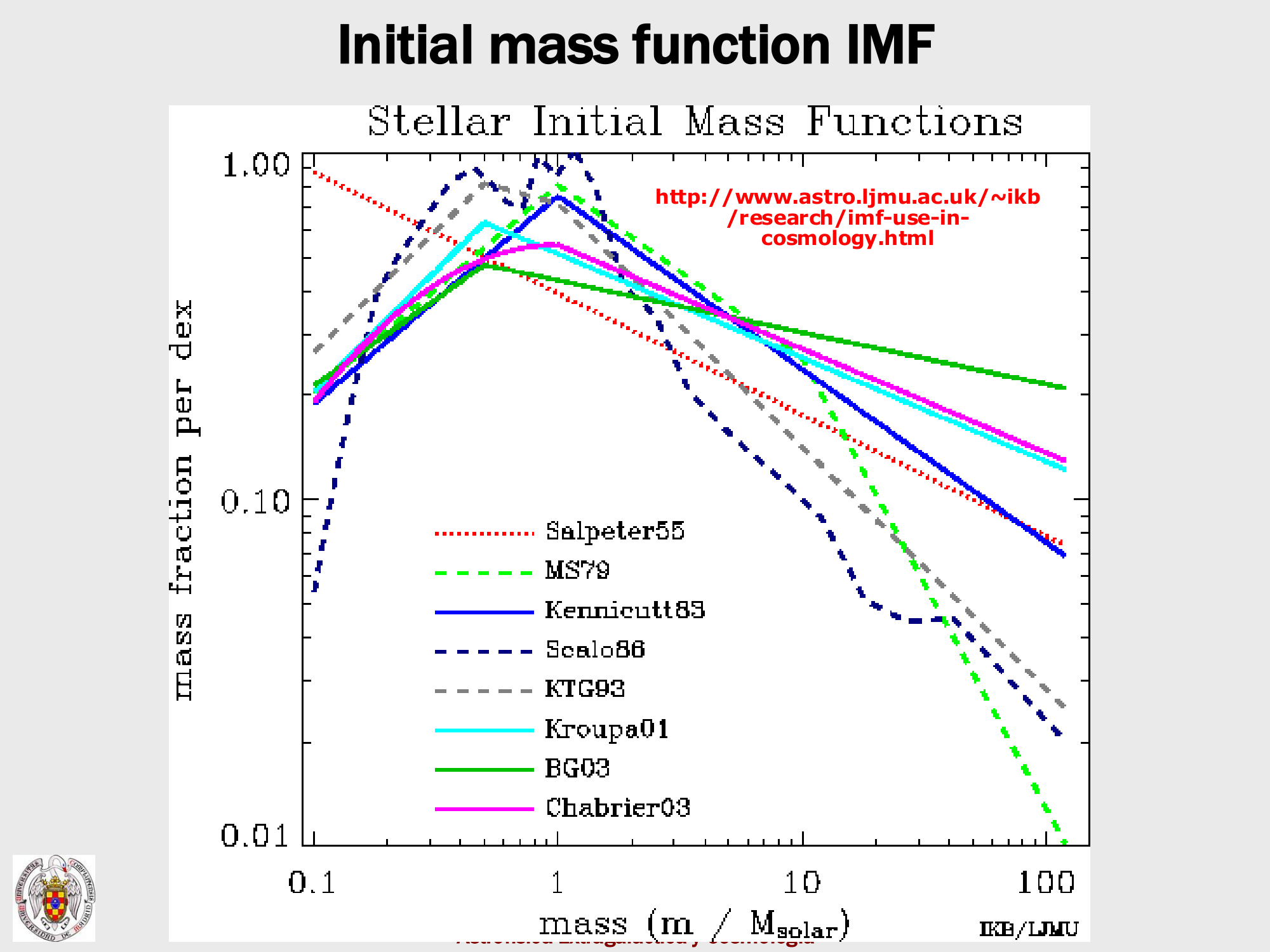
- [[Initial mass function]] - Salpeter 1955 ($\alpha = 2.35$), Kroupa 2001, Chabrier 2003
SFR tracers across the spectrum
- [[UV SFR tracer]] - Kennicutt 1998, $1.4 \times 10^{-28} L_\nu$
- [[UV slope and IRX-beta relation]] - Meurer 1999, dust correction without IR
- [[Dust attenuation and extinction curves]] - Calzetti 2000, Cardelli 1989, Charlot & Fall 2000
- [[H-alpha SFR tracer]] - $7.9 \times 10^{-42} L(\text{H}\alpha)$, 10 Myr timescale
- [[Balmer decrement]] - $F(\text{H}\alpha)/F(\text{H}\beta) = 2.86$ for case B
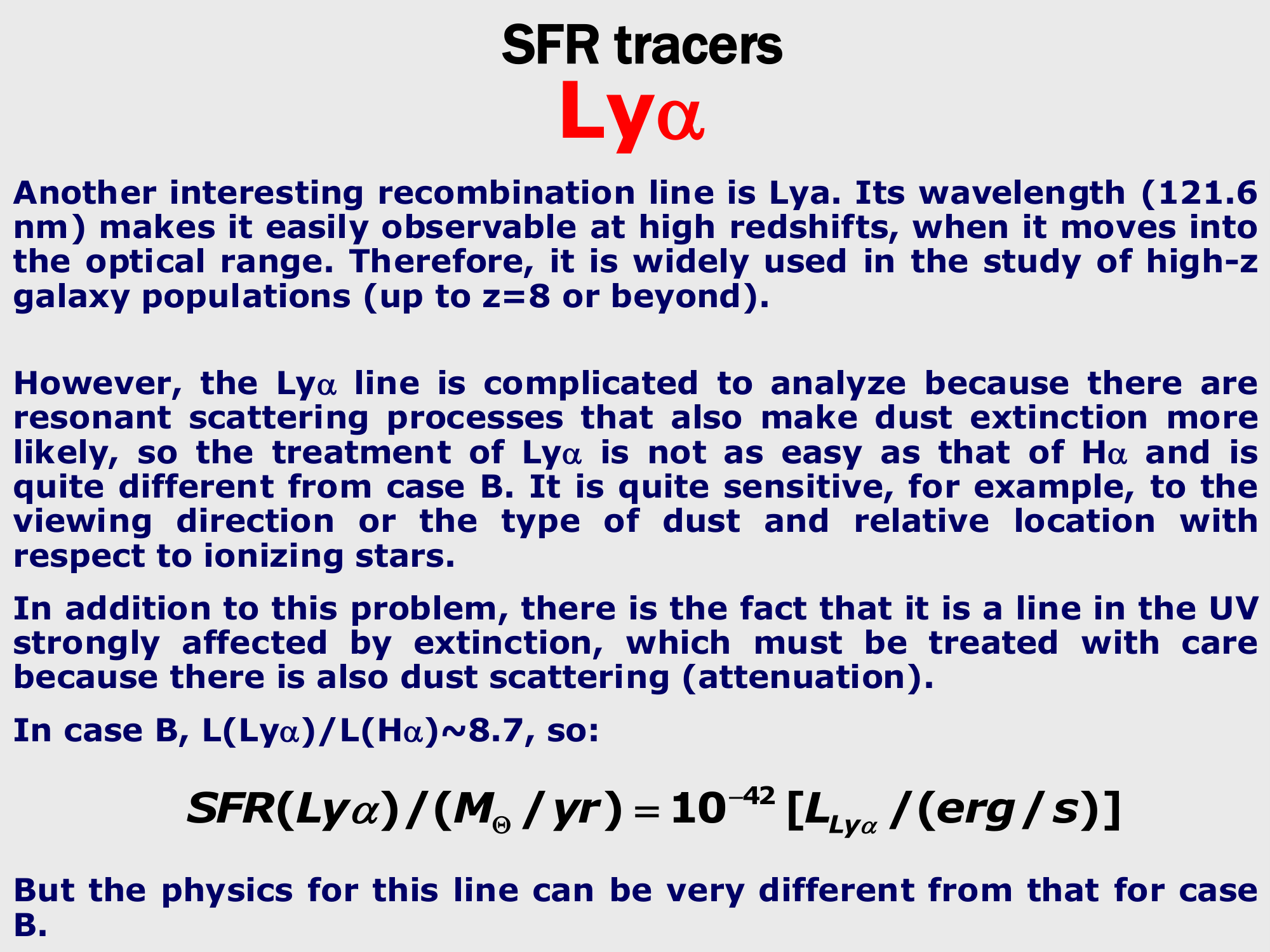
- [[Lyman alpha SFR tracer]] - resonance scattering, Verhamme 2008
- [[OII SFR tracer]] - forbidden, metallicity-dependent, redshift-desert tool
- [[Other SFR tracer lines]] - Pα, [CII] 158 μm, PAHs, radio recombination
- [[X-ray SFR tracer]] - HMXBs + diffuse, Ranalli 2003, metallicity dependence
- [[IR SFR tracer]] - $4.5 \times 10^{-44} L_{\text{TIR}}$, Pérez-González 2006
- [[Radio SFR tracer]] - FIR-radio correlation $q \simeq 2.3$, Murphy 2011
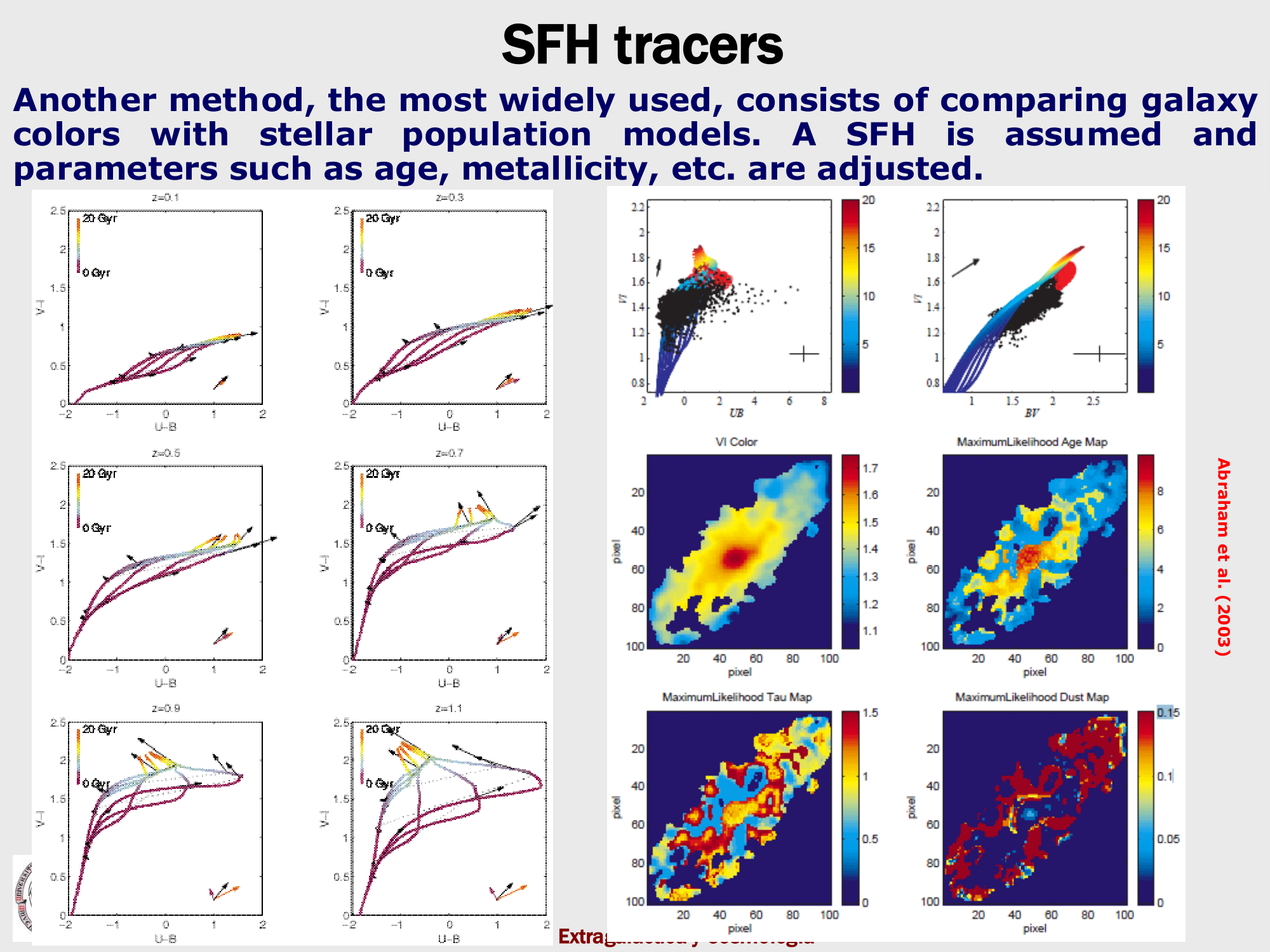
- [[SFR tracer comparison]] - Cardiel 2003, tracer disagreements as diagnostics
SFH reconstruction and SPS
- [[SFH from resolved CMDs]] - Local Group, Ferguson 2002, Tolstoy 2009, Harris & Zaritsky 2004
- [[SED fitting for SFH]] - Papovich 2001, Pérez-González 2008, modern codes
- [[Stellar population synthesis]] - BC03, Maraston 2005, FSPS, Starburst99, Lick indices
Galaxy classes
- [[Starburst galaxies]] - M82, Wolf-Rayet, BCDs, SSCs, superwinds
- [[Post-starburst galaxies]] - E+A, Balmer absorption, Kriek 2010
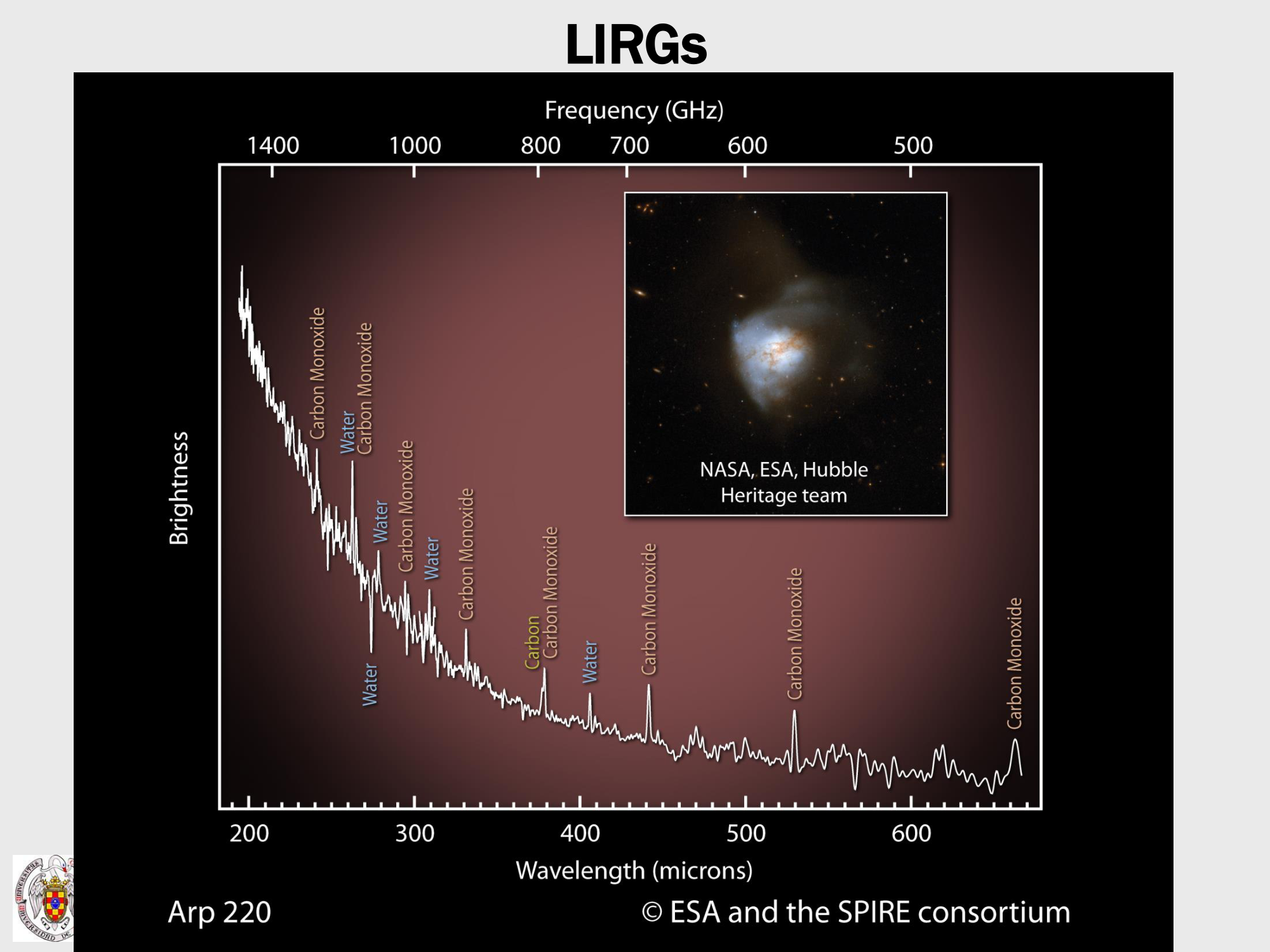
- [[LIRGs ULIRGs HyLIRGs]] - IRAS 1983, Sanders & Mirabel 1996, Arp 220
- [[Galaxy mergers and SF]] - $f_m \propto (1+z)^{2-3}$, merger-ULIRG-elliptical sequence
Chemical evolution
- [[Chemical evolution of galaxies]] - Tinsley 1979, α/Fe clock, mass-metallicity, yields
Lecture 1C - nuclear activity and supermassive black holes in galaxies
- [[Pablo_04_Nuclear_activity_in_galaxies]] - the master overview of accretion physics, AGN demographics, and feedback
Accretion engines and unified model
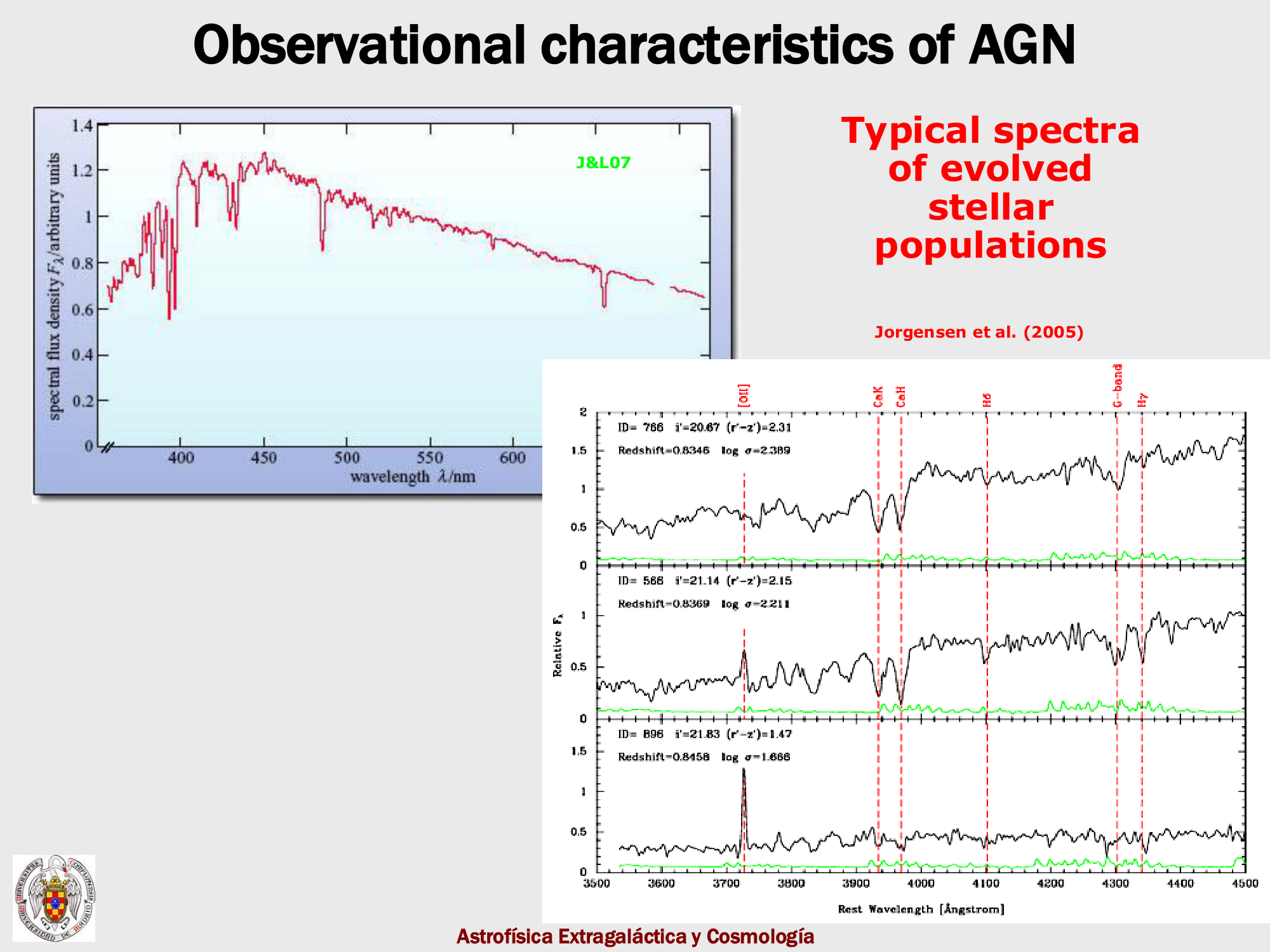
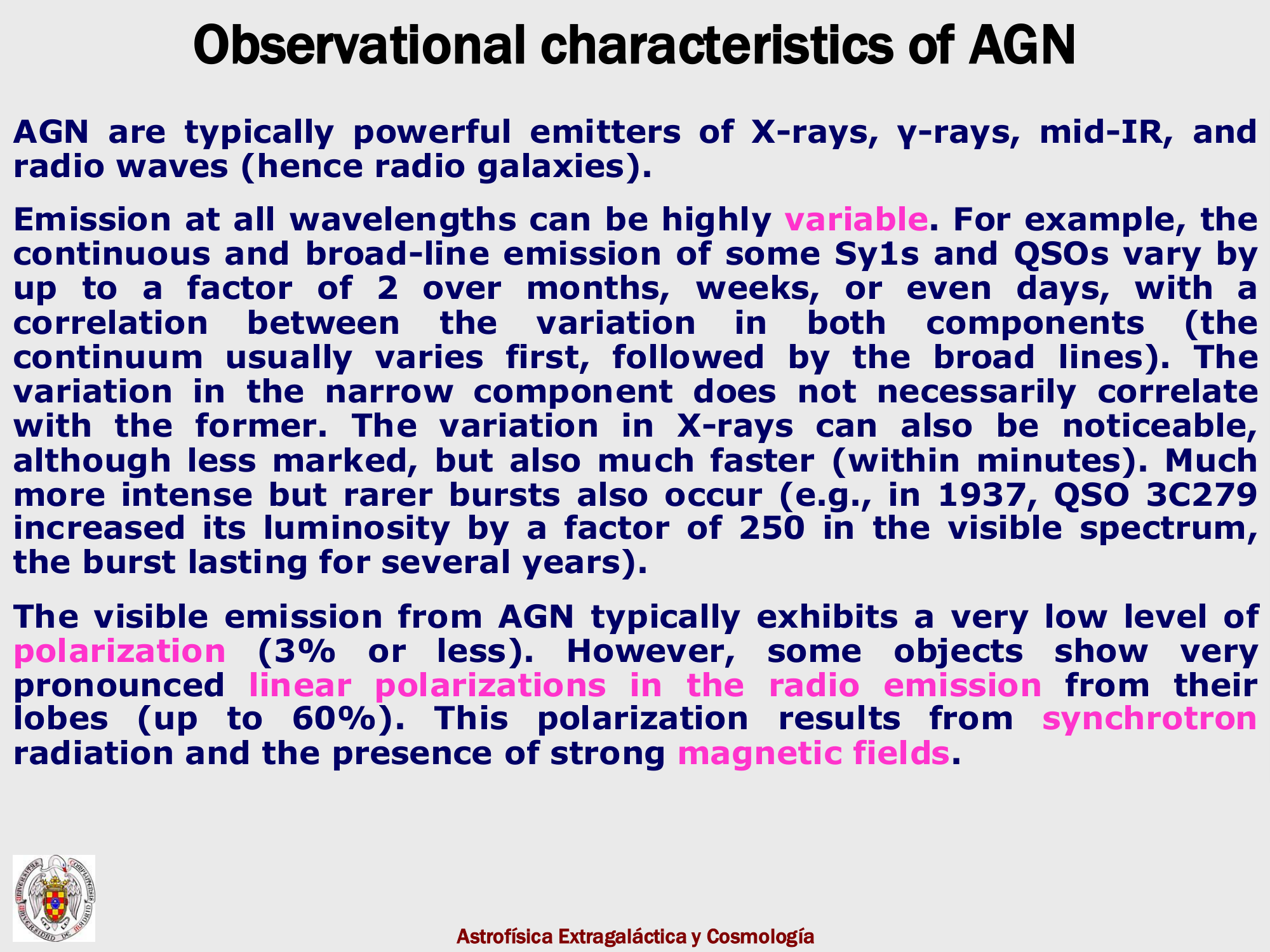
- [[AGN taxonomy unified model and feedback]] - Eddington limit, Antonucci-Miller unified model, Magorrian / M-sigma relations, and quasar vs radio mode feedback
- [[AGN and supermassive black holes]] - EHT event-horizon shadows (M87, Sgr A), relativistic jets, and GRAVITY BLR kinematics
Spectroscopic classification
- [[BPT emission line diagnostic diagram]] - [O III]/Hβ vs [N II]/Hα line ratios, Kewley vs Kauffmann starburst boundaries, Seyferts, and LINERs
Lecture 1D - galaxies at cosmological distances and cosmic dawn
- [[Pablo_05_Galaxies_at_cosmological_distances]] - the master overview of high-z galaxy selection, JWST discoveries, and structural evolution
High-redshift selection and cosmic dawn
- [[High-redshift galaxy selection and Lyman break technique]] - 912 Å photoelectric dropouts (U, B, V dropouts), LAEs, and sub-mm galaxies
- [[Cosmic dawn and high-redshift galaxies with JWST]] - JADES-GS-z14-0 ($z=14.32$), $z > 10$ overabundance puzzle, and Little Red Dots (LRDs)
Morphology and SED analysis
- [[Non-parametric galaxy morphology metrics]] - CAS system ($C, A, S$), Gini coefficient ($G$), and $M_{20}$ merger diagnostics
- [[Galaxy SED fitting]] - multi-wavelength photometric redshifts, stellar mass estimation, and star formation history inversion
- [[Galaxy morphology vs physical properties]] - Hubble sequence physical drivers, visual classification, and environmental morphology-density relation
Literature & Primary Sources
Canonical and modern arXiv astro-ph.CO benchmark papers underlying the BAO and weak-lensing techniques above.
- [[Eisenstein_2005_BAO_Detection_SDSS_LRGs|Eisenstein et al. (2005) - BAO Detection in SDSS LRGs]] - first BAO detection, the sound horizon as a standard ruler
- [[DESI_2024_BAO_Cosmological_Constraints|DESI Collaboration (2024) - DESI 2024 VI: BAO Cosmological Constraints]] - multi-redshift BAO, hint of dynamical dark energy ($w_0,w_a$)
- [[Bartelmann_Schneider_2001_Weak_Gravitational_Lensing|Bartelmann & Schneider (2001) - Weak Gravitational Lensing]] - convergence/shear formalism, cosmic shear power spectrum
Appendices and tools
- [[Cosmology calculator - how to use H0 Omega_m Omega_Lambda to get dL dA t_lookback|Cosmology calculator - how to use H0 Ω_m Ω_Λ to get d_L, d_A, t_lookback]]
- [[Surveys to remember]] - 2dFGRS, SDSS, DEEP-2, BOSS, WiggleZ, WFMOS, 4MOST
- [[Space and ground facilities relevant for OC]] - HST, Chandra, XMM, Spitzer, Herschel, JWST, Keck, VLT, Subaru, LBT, GTC, ALMA, upcoming ELT, SKA
Dynamic Zettel Index (Dataview)
LIST
FROM "03_Zettel/Theory"
WHERE contains(file.outlinks, this.file.link) OR contains(file.inlinks, this.file.link)
SORT file.name ASC
Master Figure Index (49 Total Images)
Every single publication figure, Planck CMB spectrum, 21cm cosmology plot, quasar Gunn-Peterson spectrum, and lecture slide in 07_Images/Observational_Cosmology/ is cataloged below with direct links and pedagogical context:
| Image Asset | Diagnostic Category & Cosmological Physics | Primary Zettel Note |
|---|---|---|
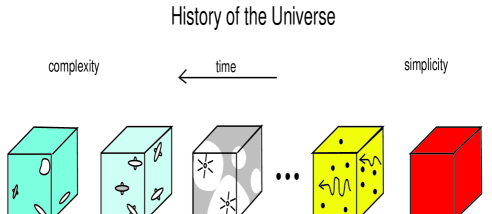 |
Barkana & Loeb reionization timeline, dark matter halo mass threshold, and density fluctuations | [[Cosmic dawn and high-redshift galaxies with JWST]] |
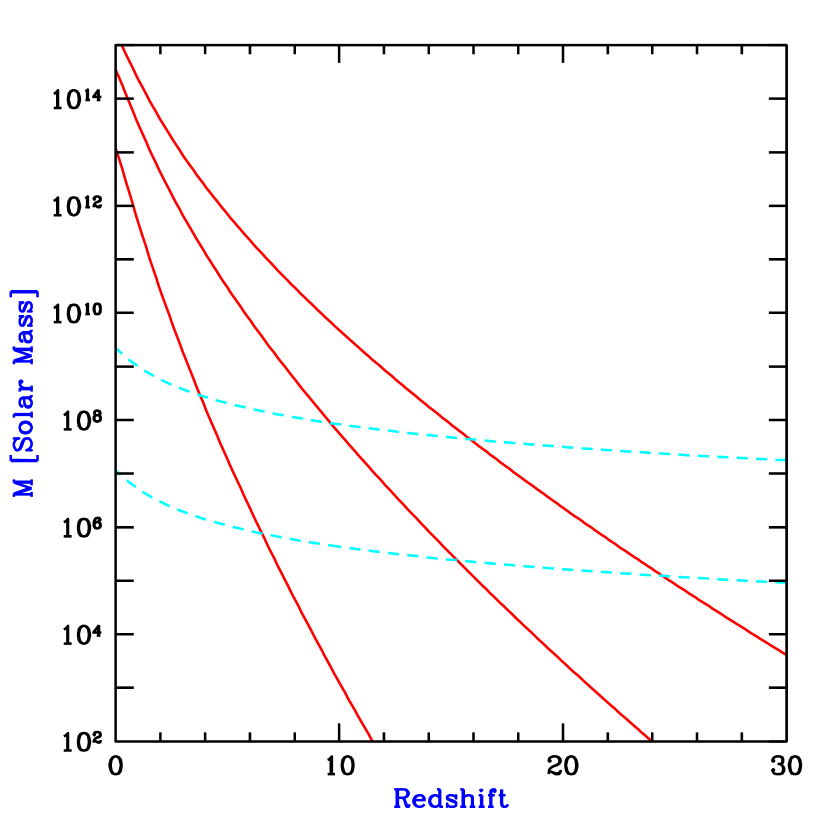 |
Barkana & Loeb reionization timeline, dark matter halo mass threshold, and density fluctuations | [[Cosmic dawn and high-redshift galaxies with JWST]] |
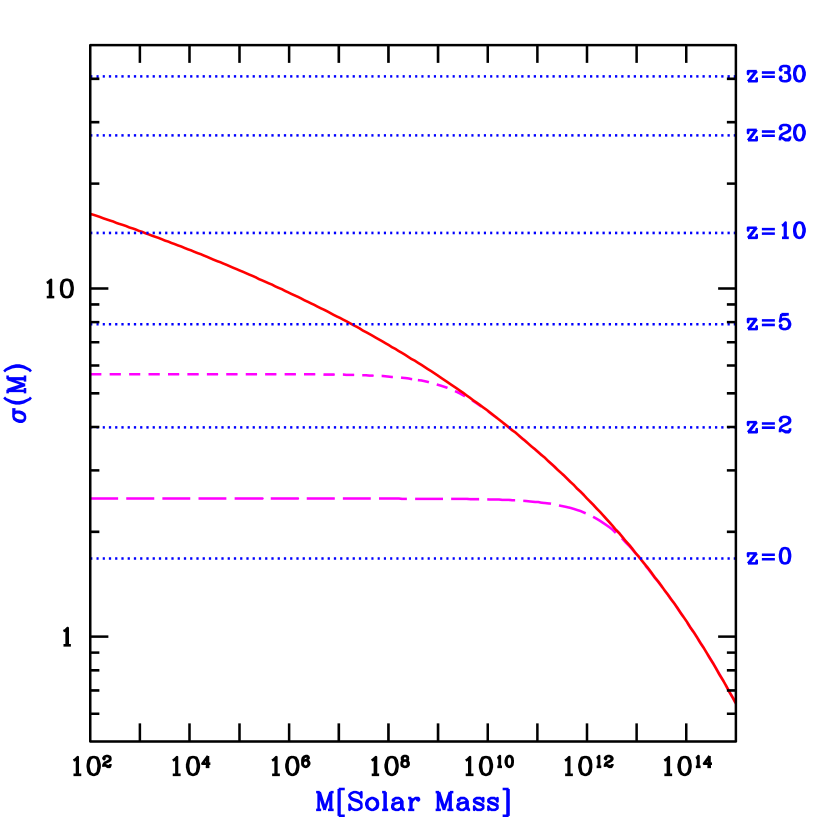 |
Barkana & Loeb reionization timeline, dark matter halo mass threshold, and density fluctuations | [[Cosmic dawn and high-redshift galaxies with JWST]] |
 |
Barkana & Loeb reionization timeline, dark matter halo mass threshold, and density fluctuations | [[Cosmic dawn and high-redshift galaxies with JWST]] |
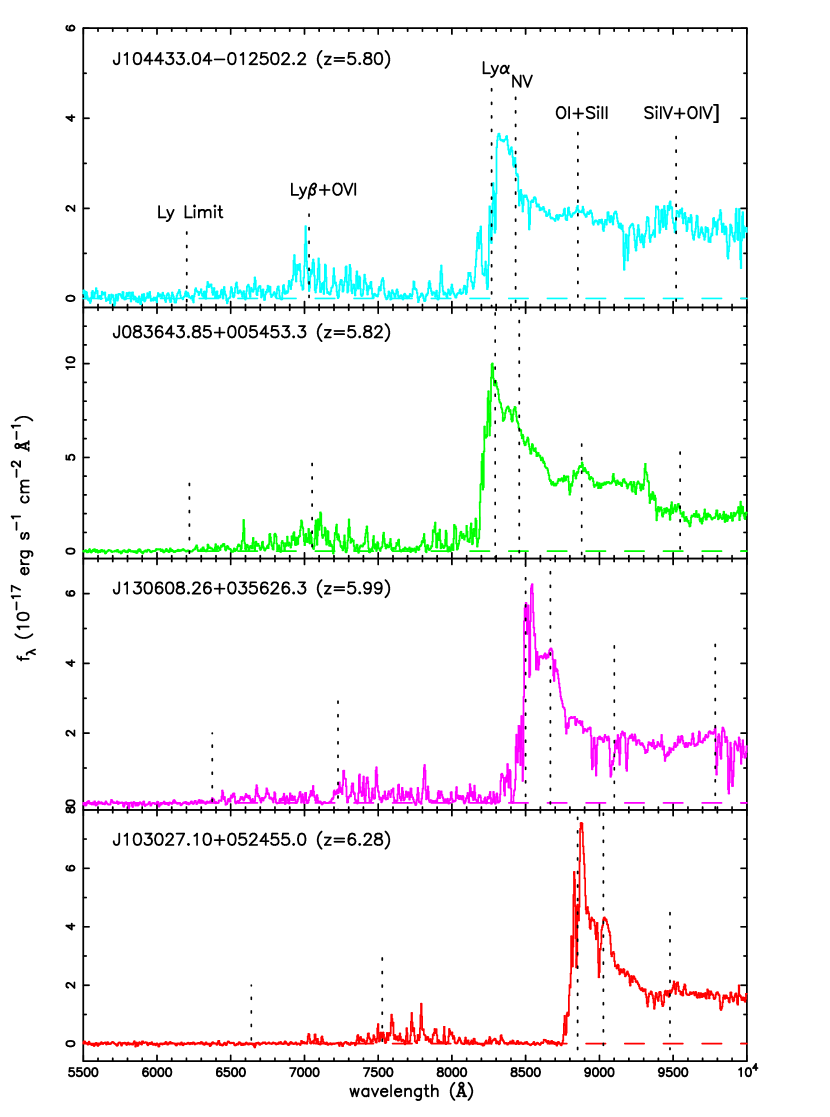 |
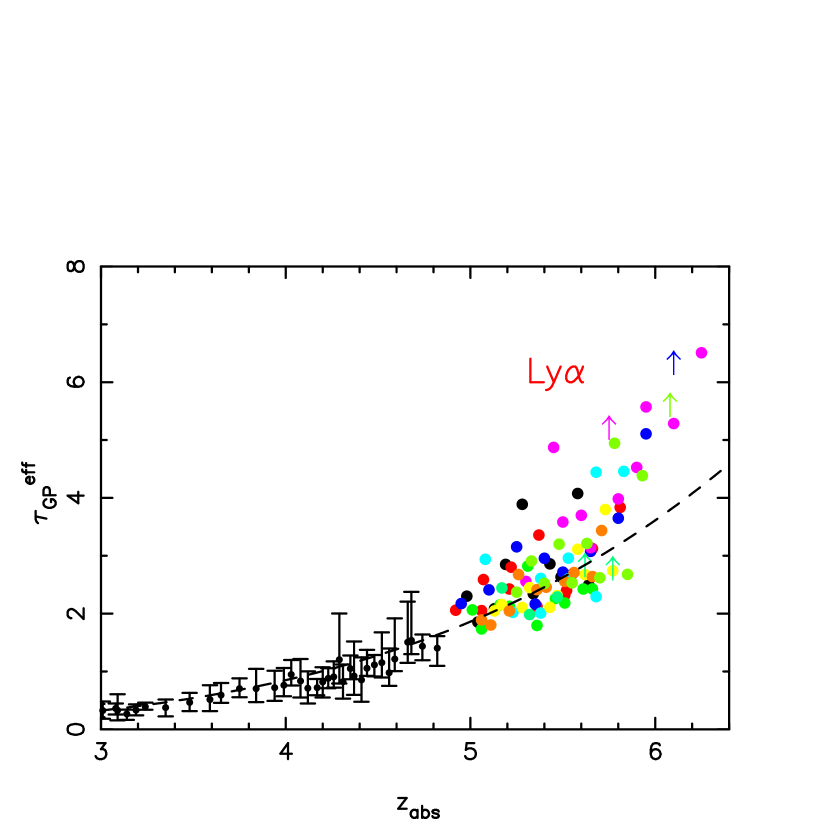
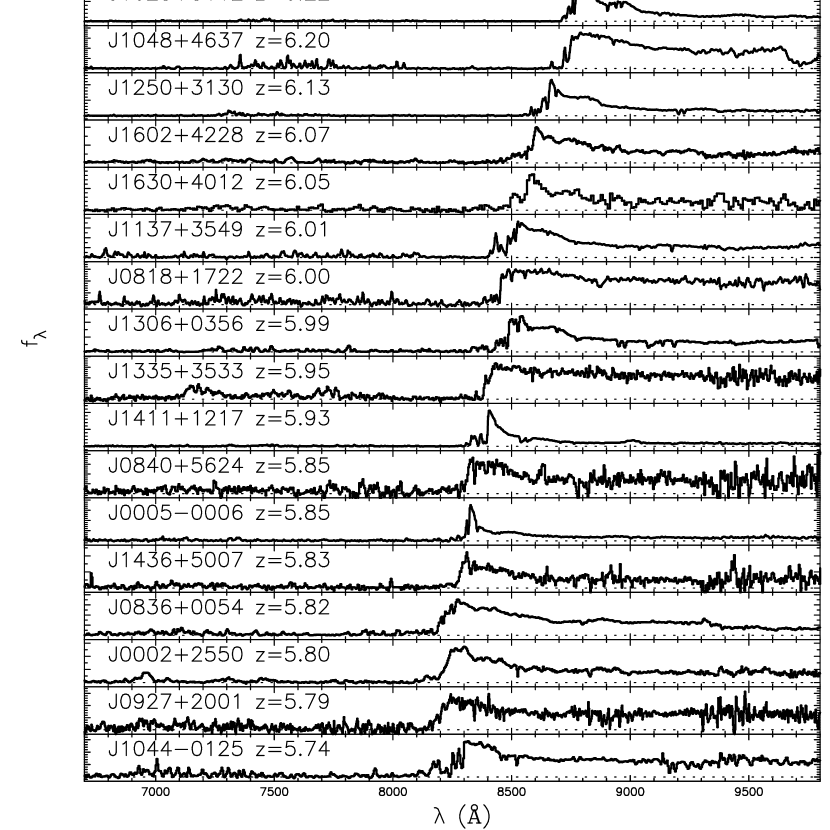
SDSS $z \sim 6$ quasar absorption spectra, Gunn-Peterson trough, and effective optical depth $\tau_{\rm eff}$ | [[Reionization]] |
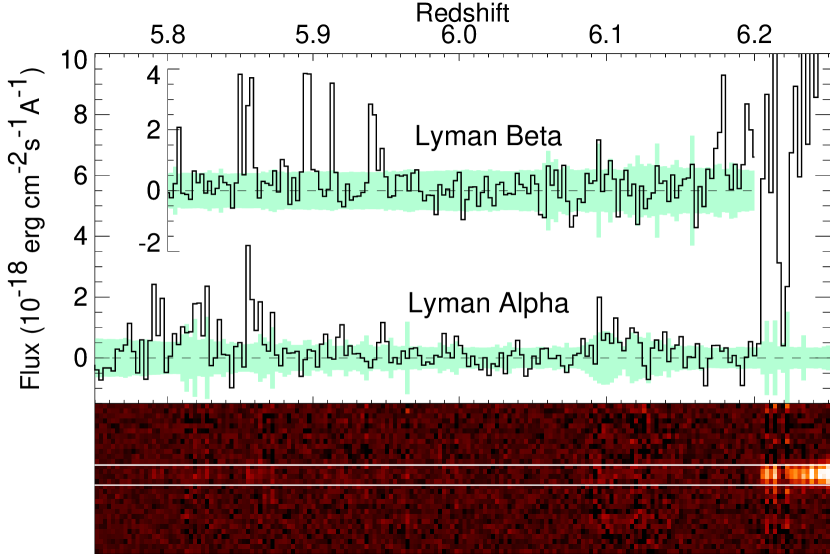 |
SDSS $z \sim 6$ quasar absorption spectra, Gunn-Peterson trough, and effective optical depth $\tau_{\rm eff}$ | [[Reionization]] |
 |
SDSS $z \sim 6$ quasar absorption spectra, Gunn-Peterson trough, and effective optical depth $\tau_{\rm eff}$ | [[Reionization]] |
 |
SDSS $z \sim 6$ quasar absorption spectra, Gunn-Peterson trough, and effective optical depth $\tau_{\rm eff}$ | [[Reionization]] |
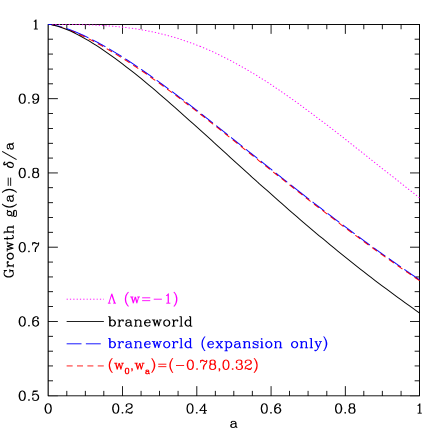 |
Linder growth factor $D(z)$ and growth rate parameter $f(z) = \Omega_m(z)^\gamma$ | [[Growth factor D(z)]] |
 |
Padova Observational Cosmology lecture slide: High-z dropouts, BAO standard ruler, or perturbation equations | [[Brief thermal history]] |
 |
Padova Observational Cosmology lecture slide: High-z dropouts, BAO standard ruler, or perturbation equations | [[Brief thermal history]] |
 |
Padova Observational Cosmology lecture slide: High-z dropouts, BAO standard ruler, or perturbation equations | [[Brief thermal history]] |
 |
Padova Observational Cosmology lecture slide: High-z dropouts, BAO standard ruler, or perturbation equations | [[Brief thermal history]] |
 |
Padova Observational Cosmology lecture slide: High-z dropouts, BAO standard ruler, or perturbation equations | [[Matter power spectrum and BAO]] |
 |
Padova Observational Cosmology lecture slide: High-z dropouts, BAO standard ruler, or perturbation equations | [[Matter power spectrum and BAO]] |
 |
Padova Observational Cosmology lecture slide: High-z dropouts, BAO standard ruler, or perturbation equations | [[Matter power spectrum and BAO]] |
 |
Padova Observational Cosmology lecture slide: High-z dropouts, BAO standard ruler, or perturbation equations | [[Matter power spectrum and BAO]] |
 |
Padova Observational Cosmology lecture slide: High-z dropouts, BAO standard ruler, or perturbation equations | [[Matter power spectrum and BAO]] |
 |
Padova Observational Cosmology lecture slide: High-z dropouts, BAO standard ruler, or perturbation equations | [[Observational_Cosmology_MOC]] |
 |
Padova Observational Cosmology lecture slide: High-z dropouts, BAO standard ruler, or perturbation equations | [[Observational_Cosmology_MOC]] |
 |
Padova Observational Cosmology lecture slide: High-z dropouts, BAO standard ruler, or perturbation equations | [[Observational_Cosmology_MOC]] |
 |
Padova Observational Cosmology lecture slide: High-z dropouts, BAO standard ruler, or perturbation equations | [[Observational_Cosmology_MOC]] |
 |
Padova Observational Cosmology lecture slide: High-z dropouts, BAO standard ruler, or perturbation equations | [[Observational_Cosmology_MOC]] |
 |
Padova Observational Cosmology lecture slide: High-z dropouts, BAO standard ruler, or perturbation equations | [[AGN taxonomy unified model and feedback]] |
 |
Padova Observational Cosmology lecture slide: High-z dropouts, BAO standard ruler, or perturbation equations | [[AGN taxonomy unified model and feedback]] |
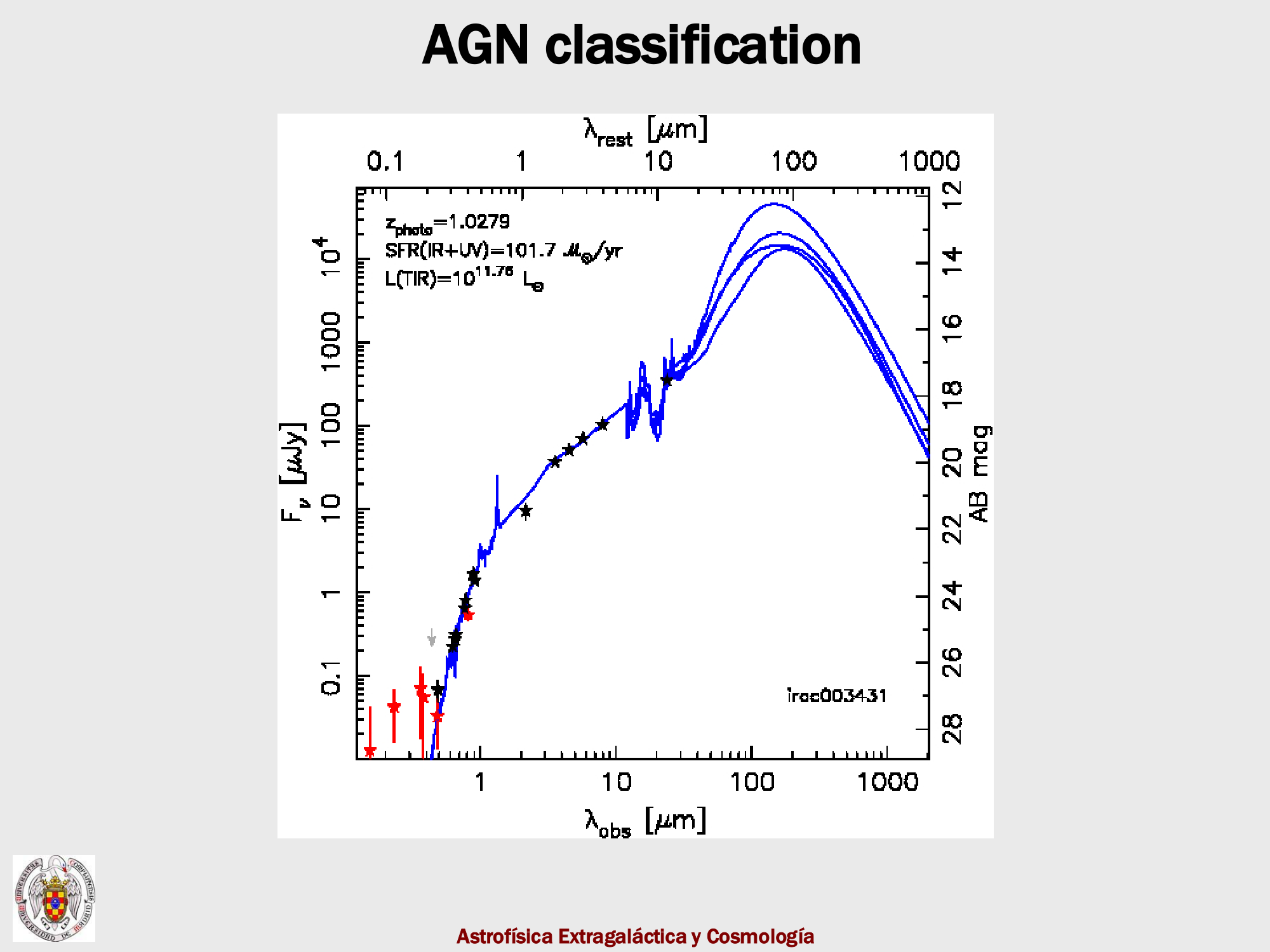 |
Padova Observational Cosmology lecture slide: High-z dropouts, BAO standard ruler, or perturbation equations | [[AGN taxonomy unified model and feedback]] |
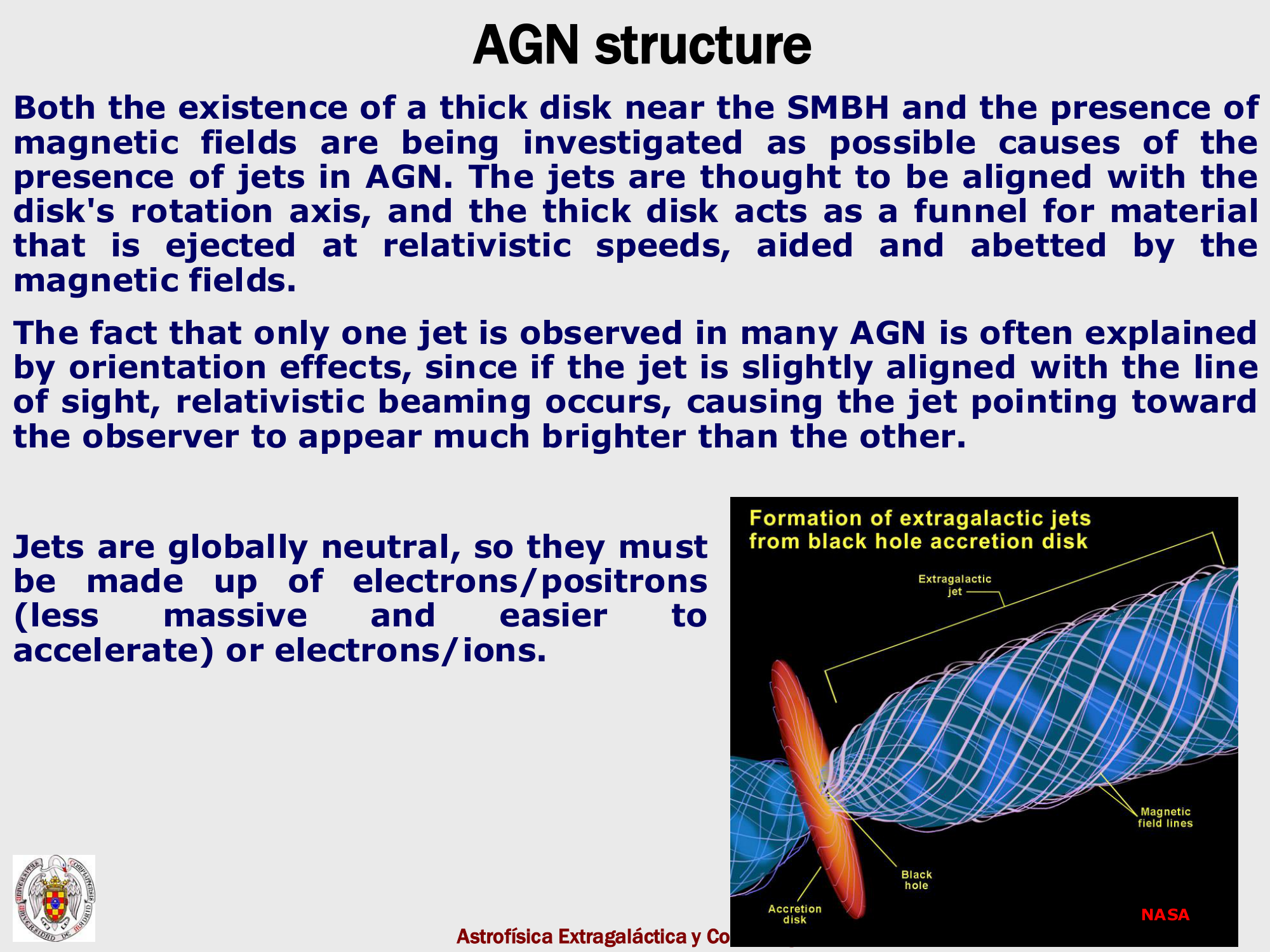 |
Padova Observational Cosmology lecture slide: High-z dropouts, BAO standard ruler, or perturbation equations | [[AGN taxonomy unified model and feedback]] |
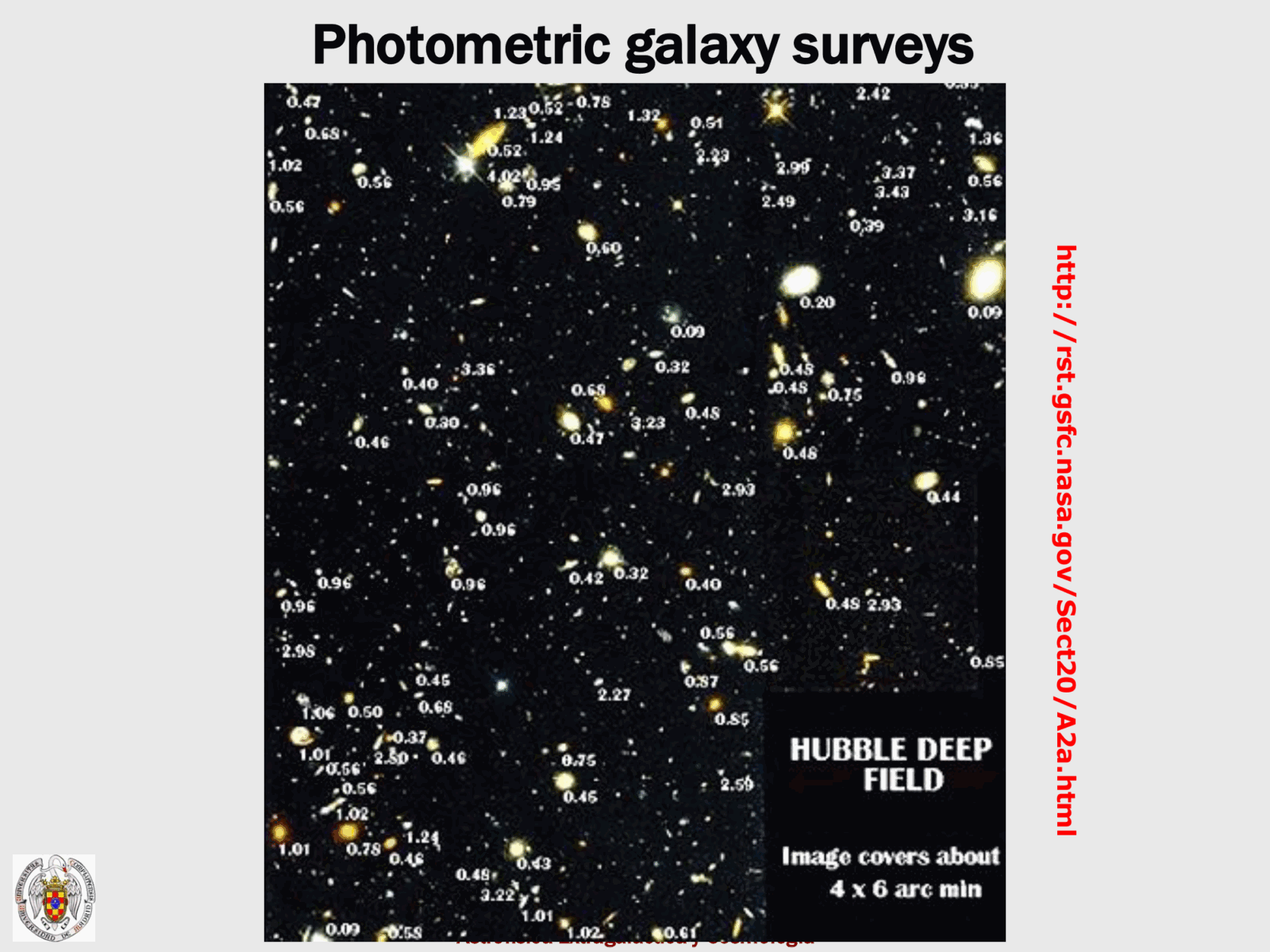 |
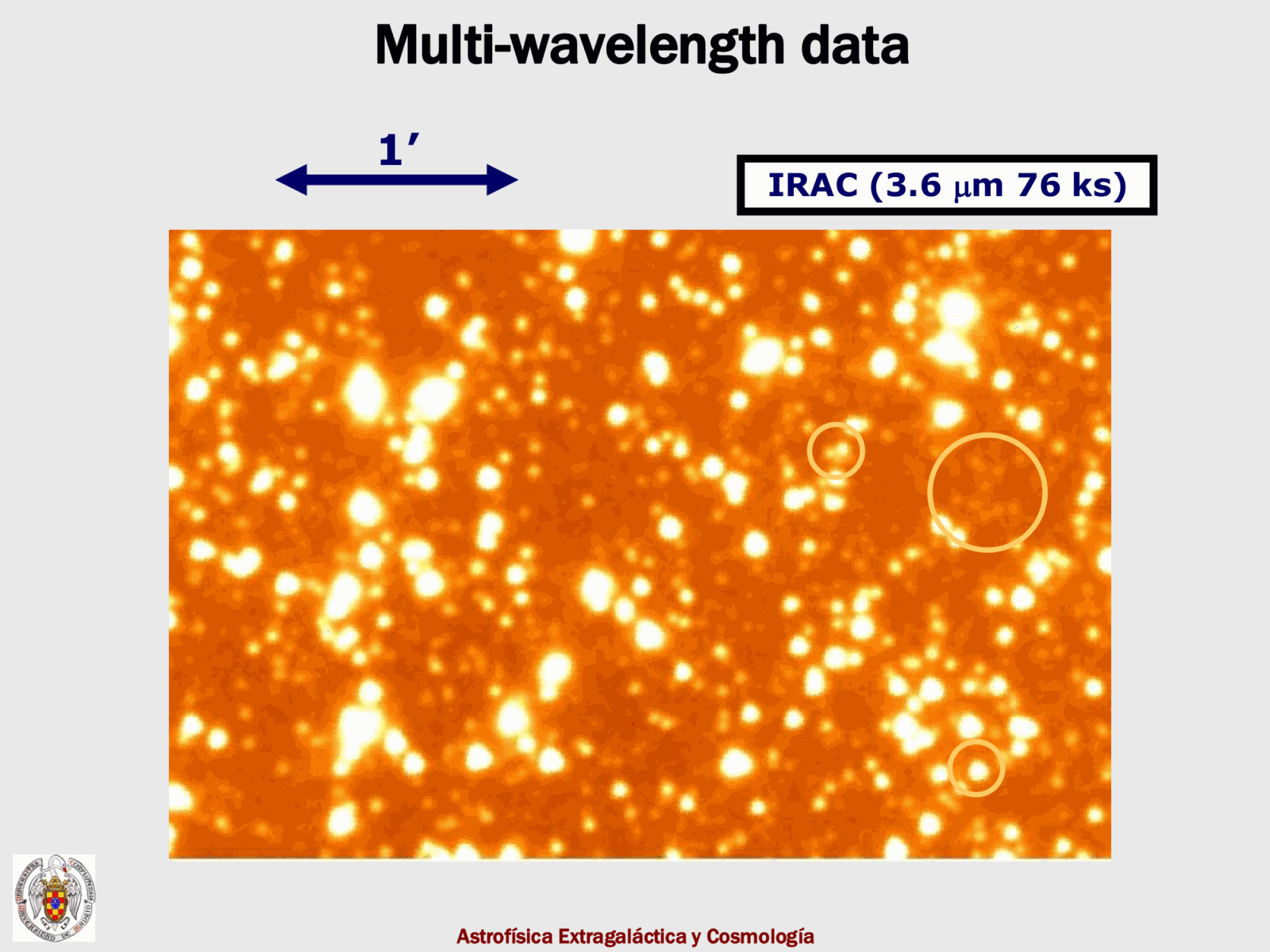
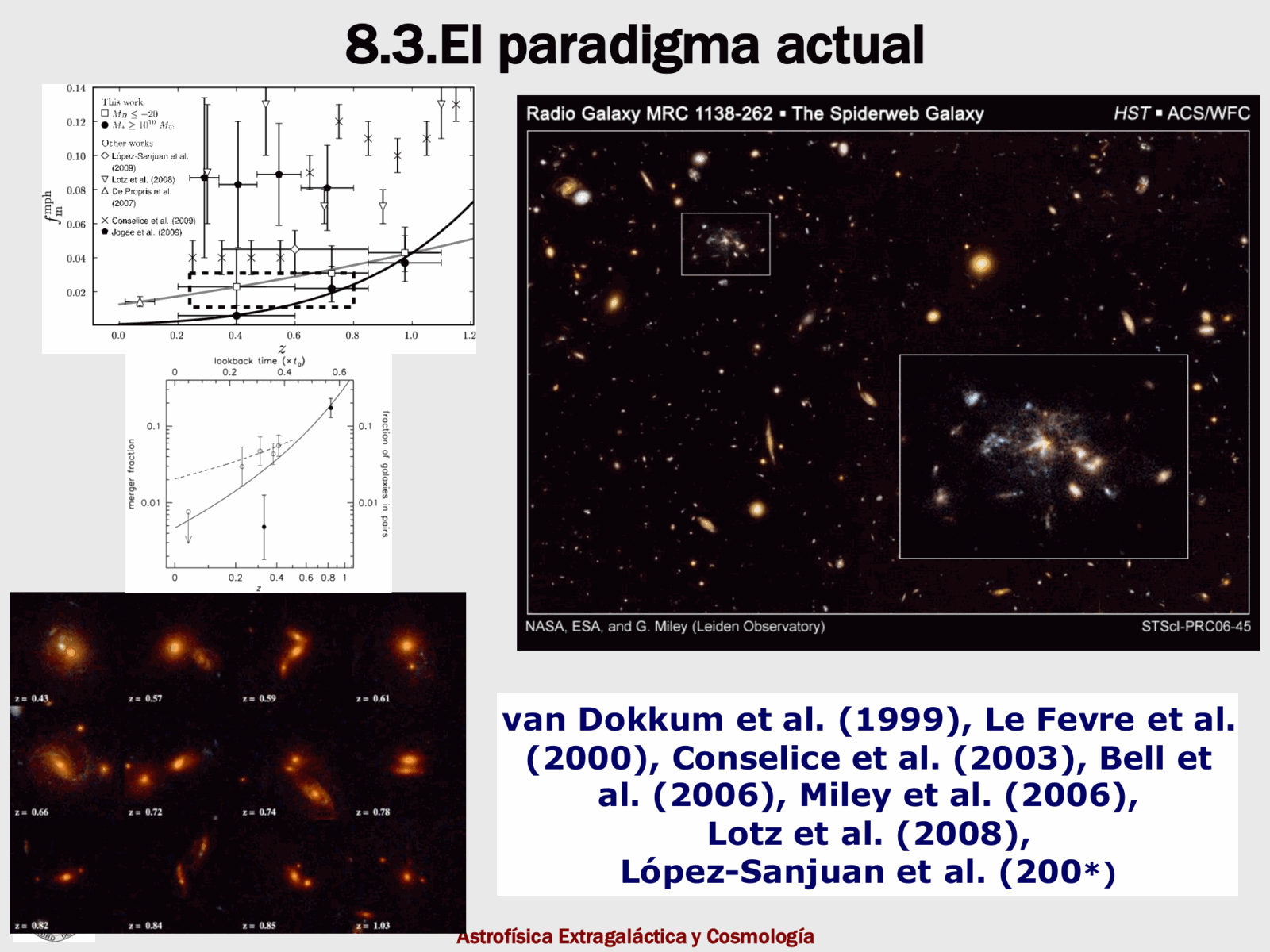
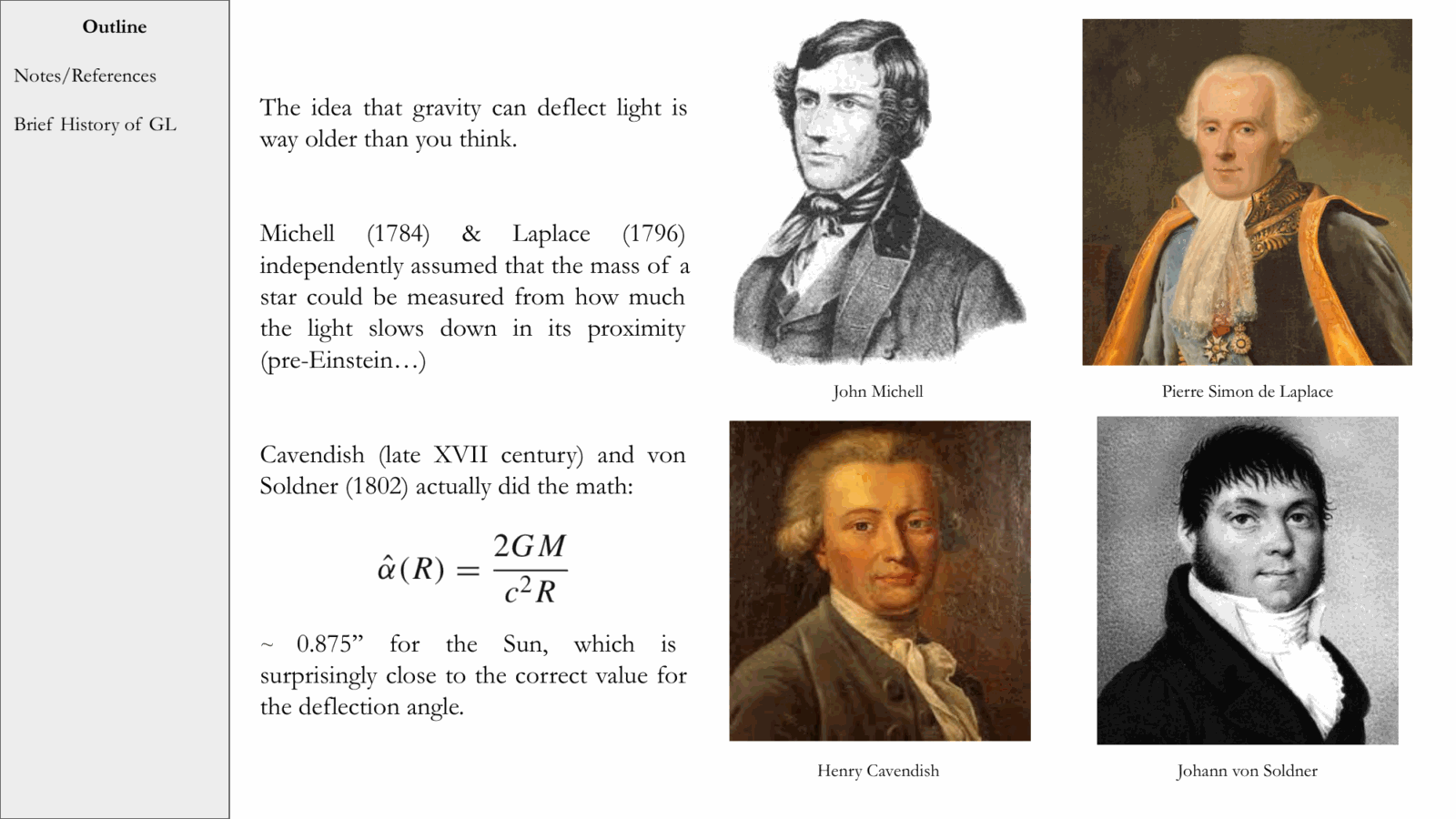
Padova Observational Cosmology lecture slide: High-z dropouts, BAO standard ruler, or perturbation equations | [[Cosmic dawn and high-redshift galaxies with JWST]] |
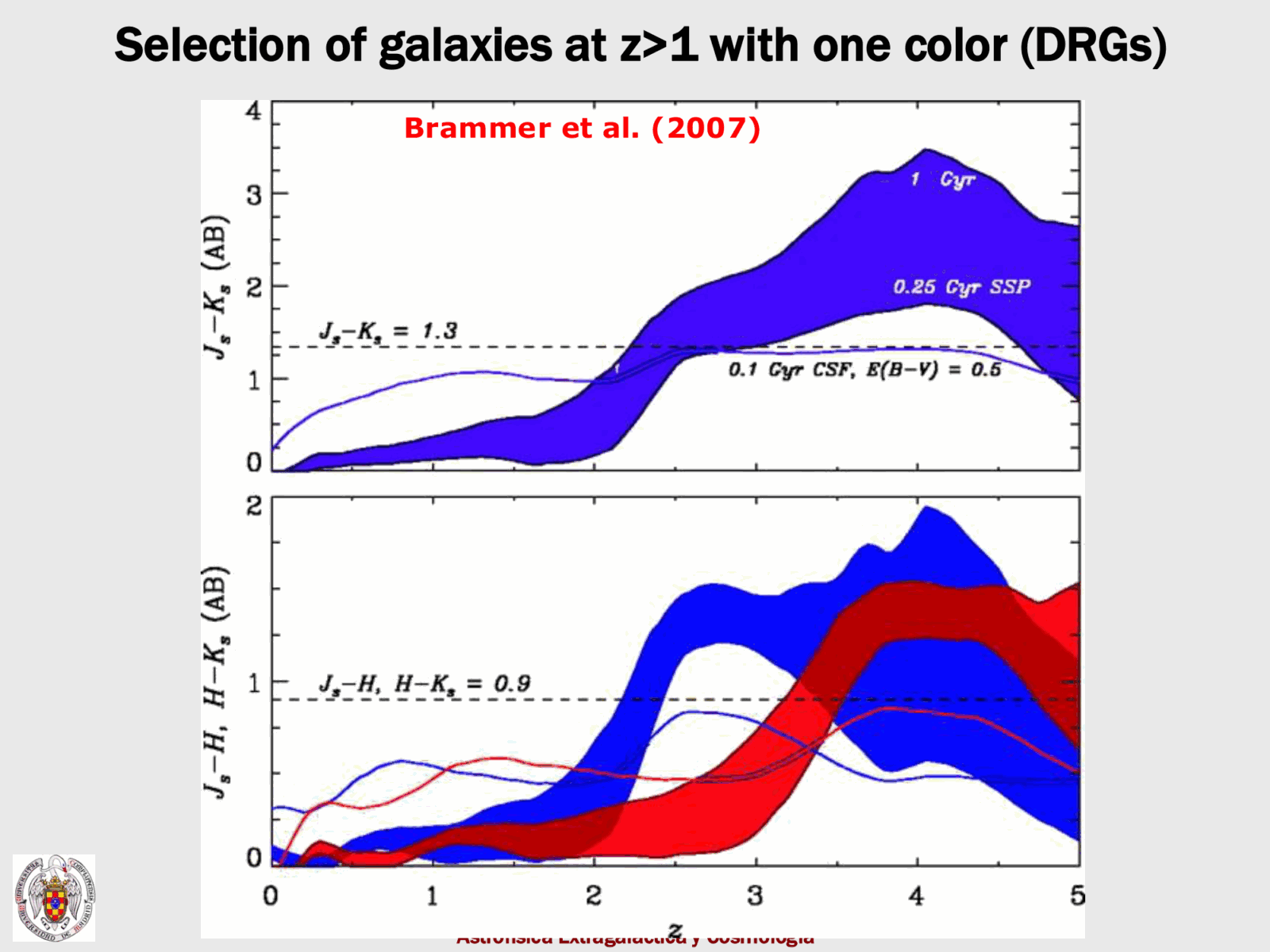 |
Padova Observational Cosmology lecture slide: High-z dropouts, BAO standard ruler, or perturbation equations | [[Cosmic dawn and high-redshift galaxies with JWST]] |
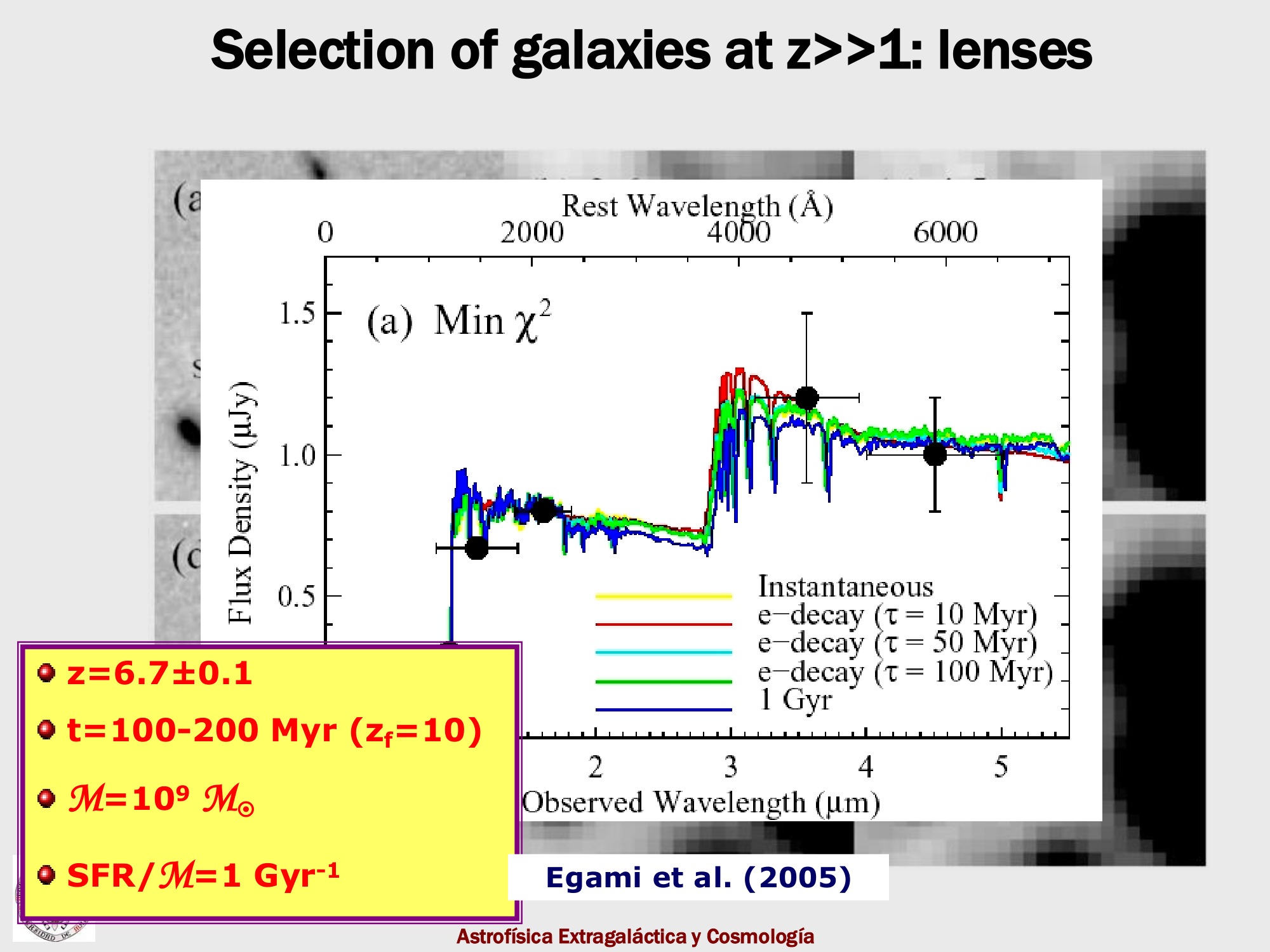 |
Padova Observational Cosmology lecture slide: High-z dropouts, BAO standard ruler, or perturbation equations | [[Cosmic dawn and high-redshift galaxies with JWST]] |
 |
Padova Observational Cosmology lecture slide: High-z dropouts, BAO standard ruler, or perturbation equations | [[Cosmic dawn and high-redshift galaxies with JWST]] |
 |
Padova Observational Cosmology lecture slide: High-z dropouts, BAO standard ruler, or perturbation equations | [[Cosmic dawn and high-redshift galaxies with JWST]] |
 |
Padova Observational Cosmology lecture slide: High-z dropouts, BAO standard ruler, or perturbation equations | [[Growth factor D(z)]] |
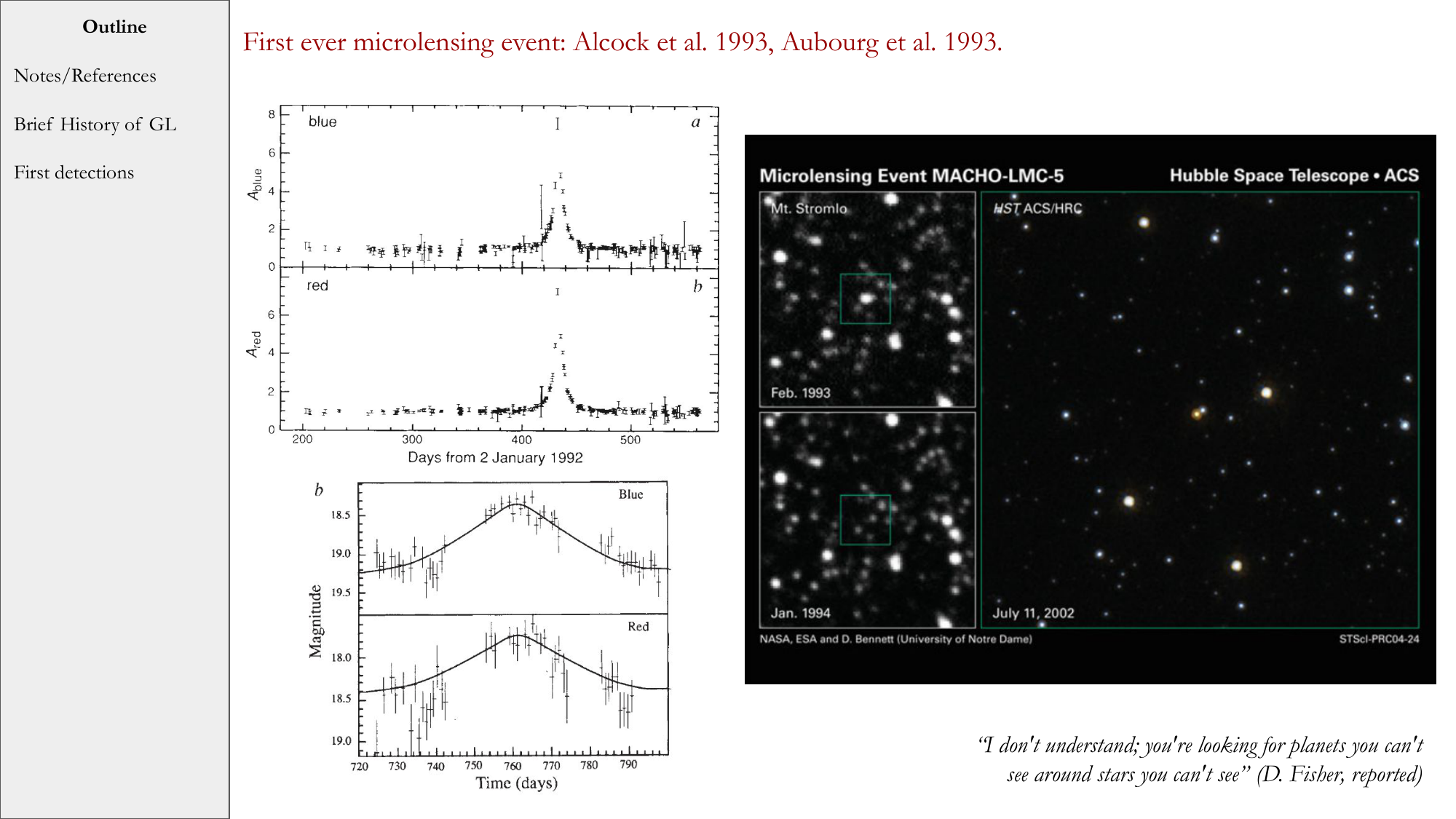 |
Padova Observational Cosmology lecture slide: High-z dropouts, BAO standard ruler, or perturbation equations | [[Growth factor D(z)]] |
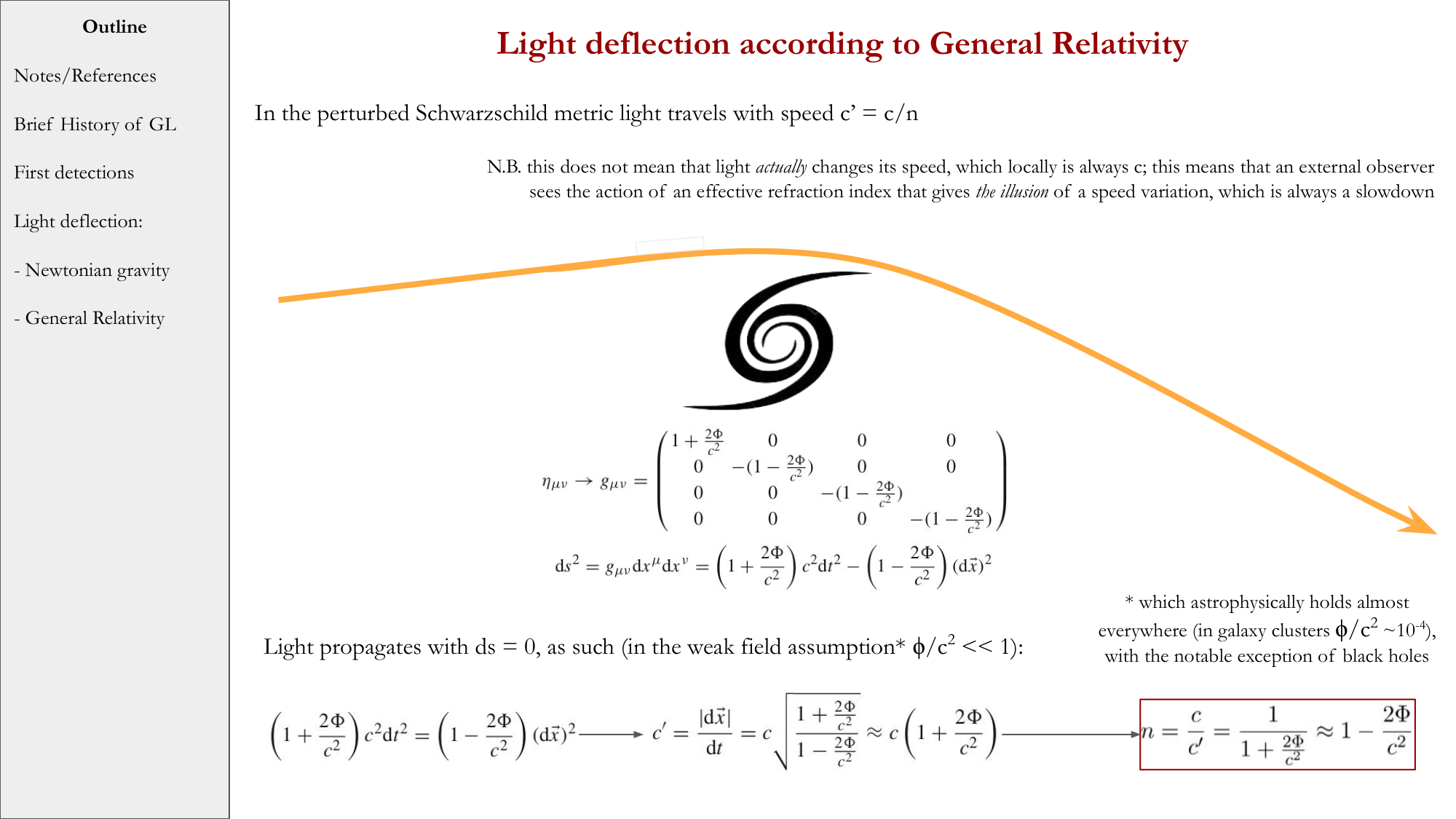 |
Padova Observational Cosmology lecture slide: High-z dropouts, BAO standard ruler, or perturbation equations | [[Growth factor D(z)]] |
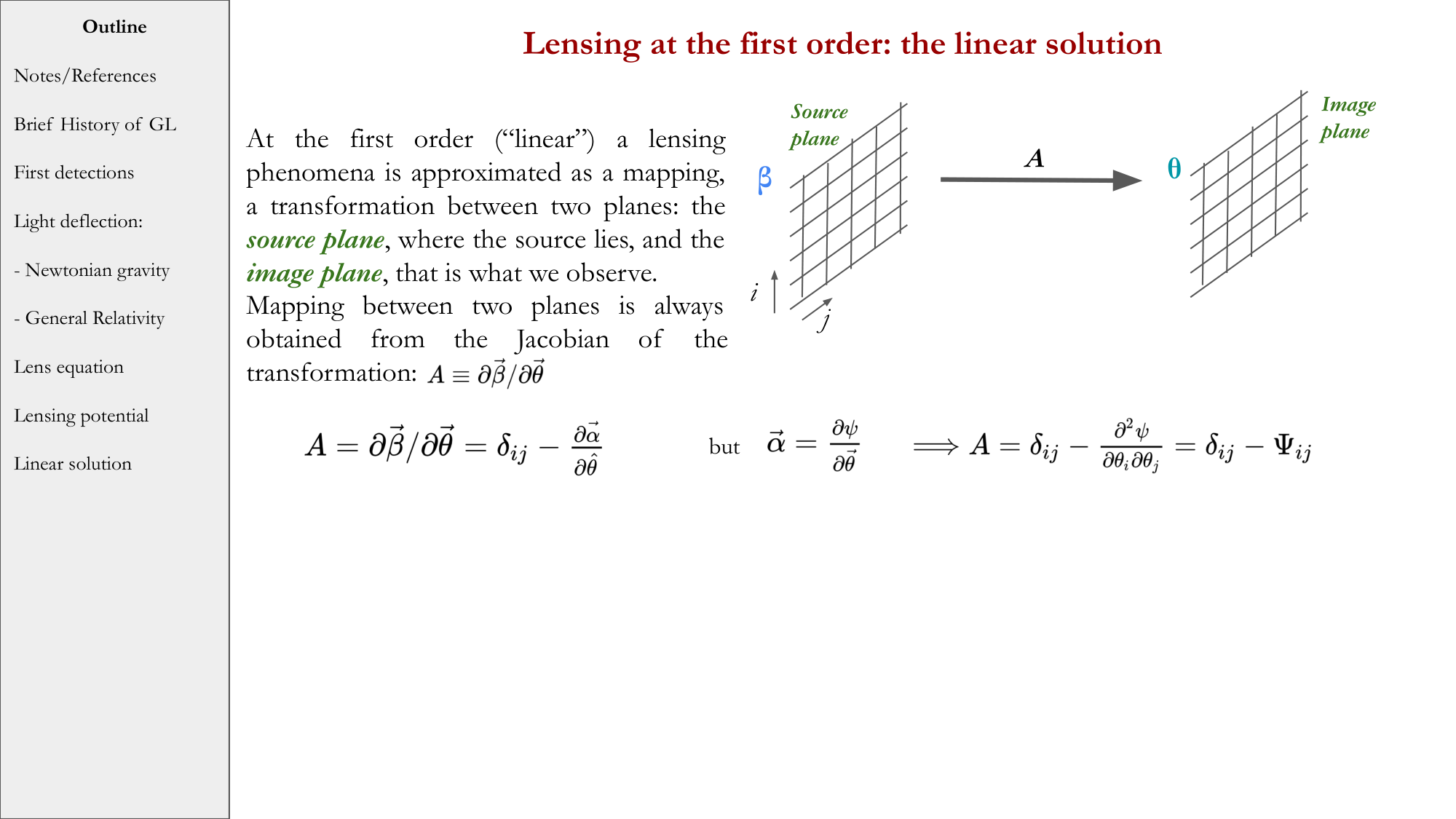 |
Padova Observational Cosmology lecture slide: High-z dropouts, BAO standard ruler, or perturbation equations | [[Growth factor D(z)]] |
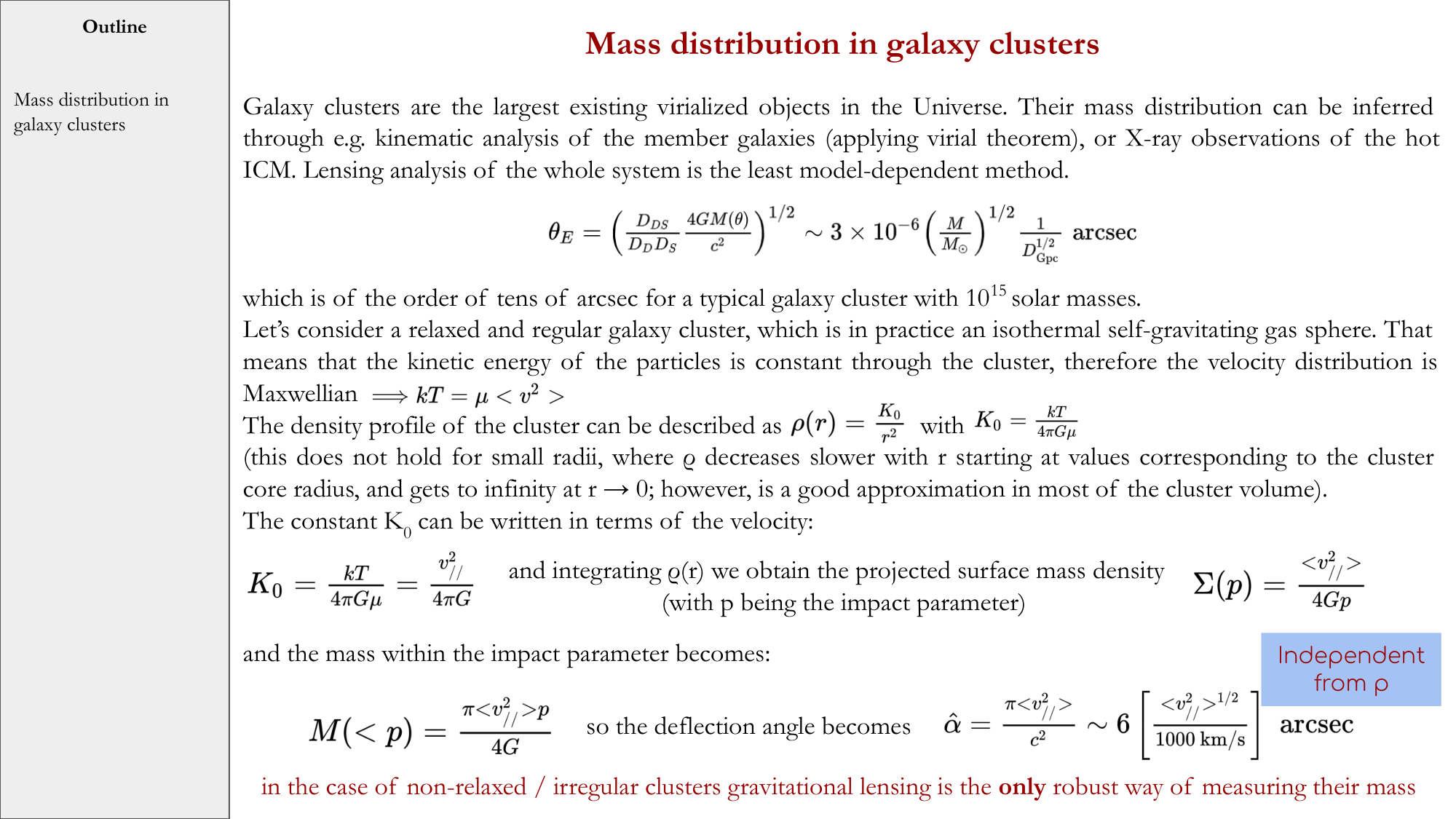 |
Padova Observational Cosmology lecture slide: High-z dropouts, BAO standard ruler, or perturbation equations | [[Cosmological evolution of perturbations in the cosmic fluid]] |
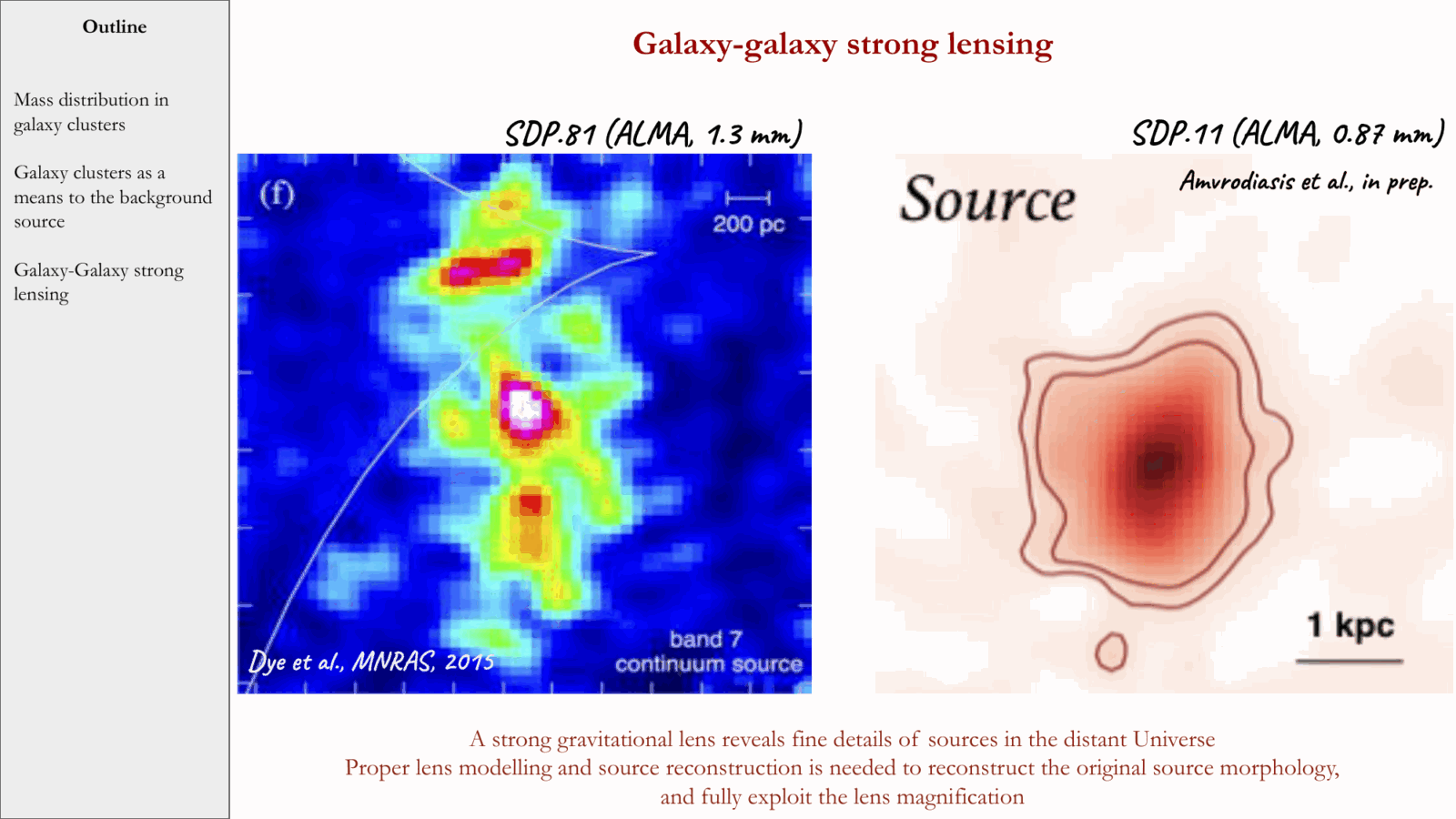 |
Padova Observational Cosmology lecture slide: High-z dropouts, BAO standard ruler, or perturbation equations | [[Cosmological evolution of perturbations in the cosmic fluid]] |
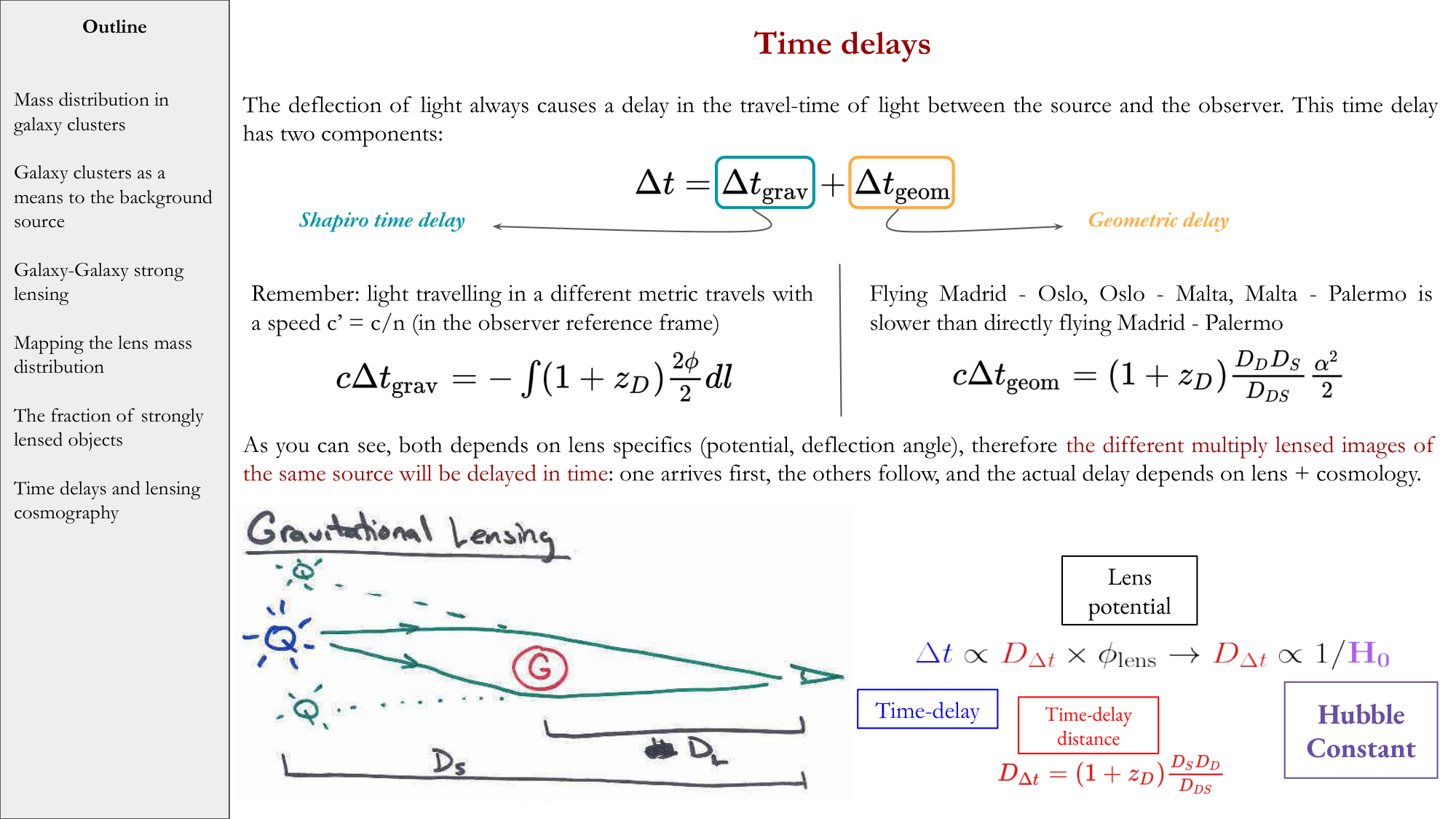 |
Padova Observational Cosmology lecture slide: High-z dropouts, BAO standard ruler, or perturbation equations | [[Cosmological evolution of perturbations in the cosmic fluid]] |
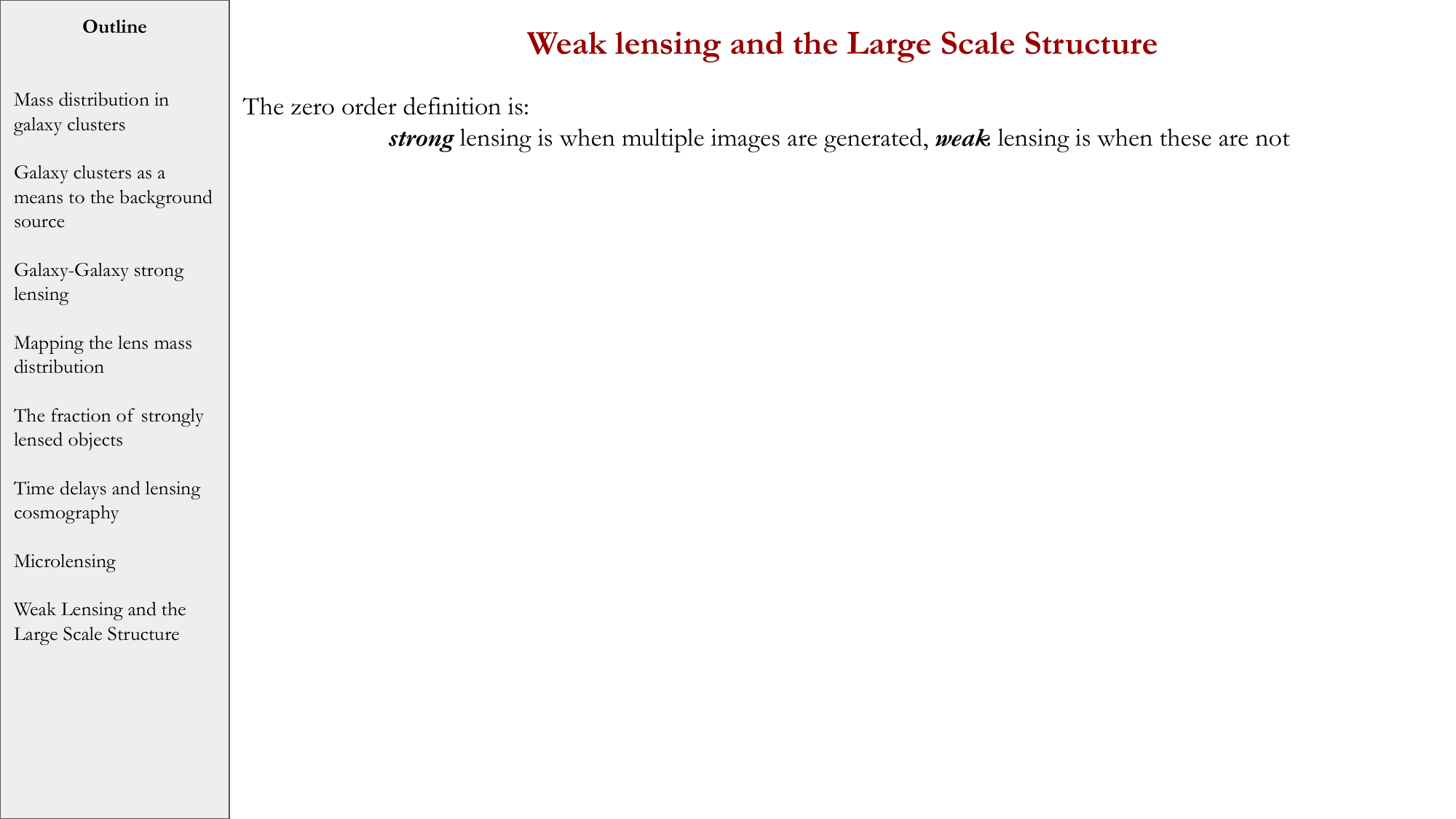 |
Padova Observational Cosmology lecture slide: High-z dropouts, BAO standard ruler, or perturbation equations | [[Cosmological evolution of perturbations in the cosmic fluid]] |
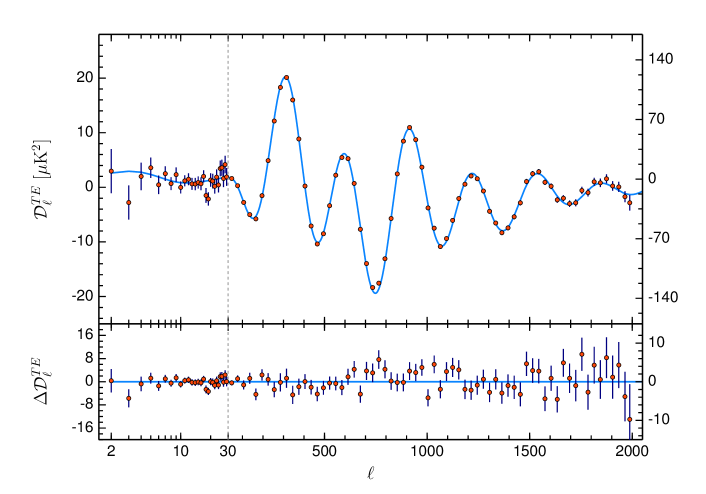 |
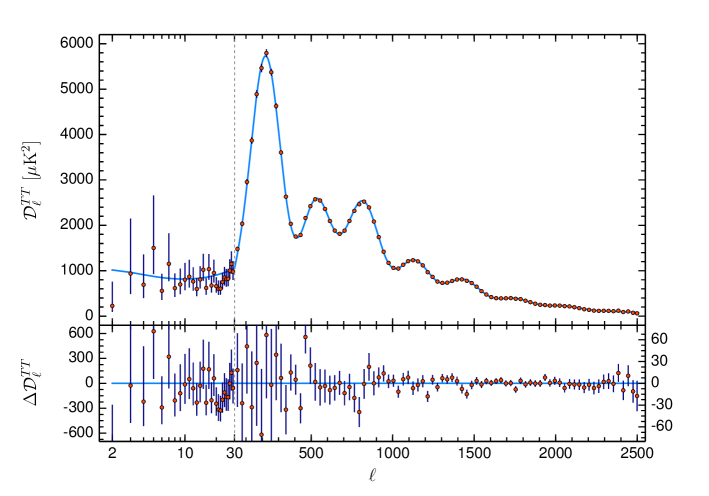
Planck 2018 CMB temperature (TT) or polarization (TE) angular power spectrum | [[CMB power spectrum]] |
 |
Planck 2018 CMB temperature (TT) or polarization (TE) angular power spectrum | [[CMB power spectrum]] |
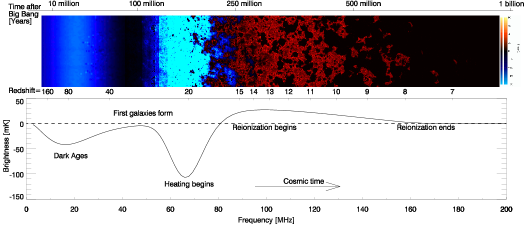 |
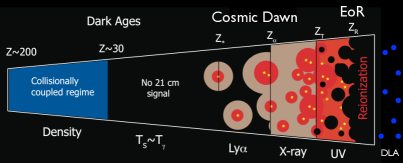
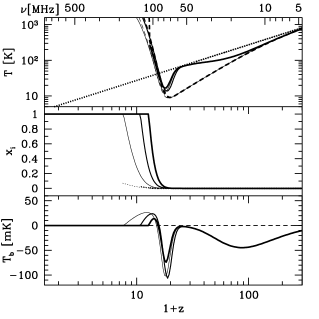
Pritchard & Loeb 21cm hydrogen line brightness temperature $\delta T_b$, spin temperature $T_S$, and cosmic phases | [[Reionization]] |
 |
Pritchard & Loeb 21cm hydrogen line brightness temperature $\delta T_b$, spin temperature $T_S$, and cosmic phases | [[Reionization]] |
 |
Observational cosmology figure, CMB power spectrum, or survey diagnostic | [[Observational_Cosmology_MOC]] |
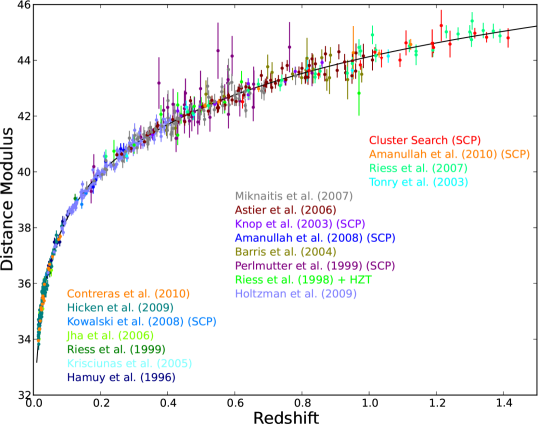 |
Supernova Cosmology Project Union2.1 SNe Ia Hubble diagram and $(\Omega_m, \Omega_\Lambda)$ confidence contours | [[Supernova Hubble diagram]] |
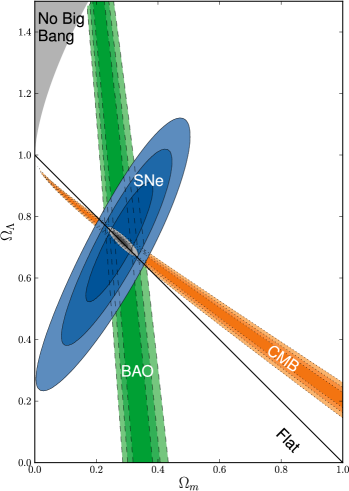 |
Supernova Cosmology Project Union2.1 SNe Ia Hubble diagram and $(\Omega_m, \Omega_\Lambda)$ confidence contours | [[Supernova Hubble diagram]] |
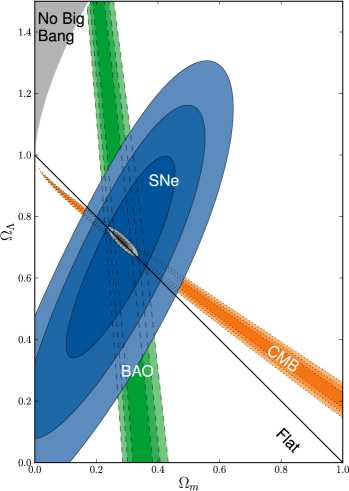 |
Supernova Cosmology Project Union2.1 SNe Ia Hubble diagram and $(\Omega_m, \Omega_\Lambda)$ confidence contours | [[Supernova Hubble diagram]] |
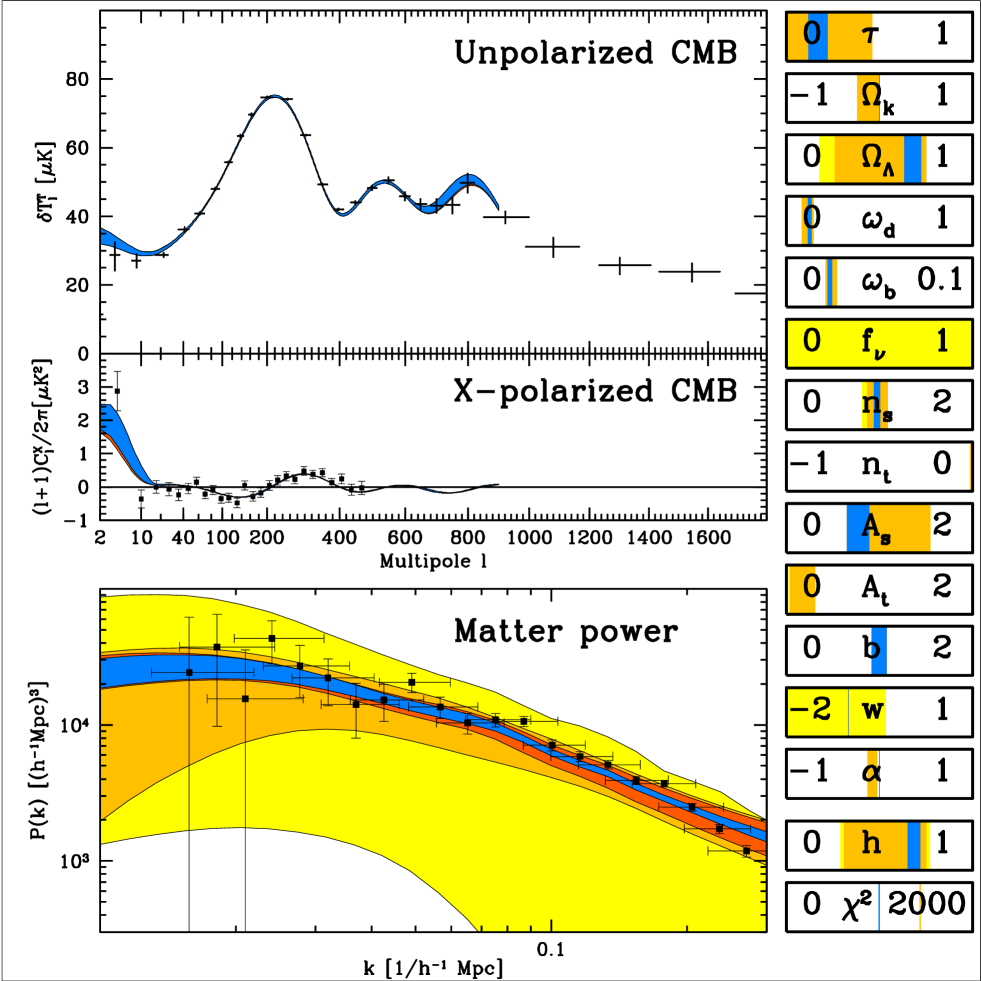 |
Tegmark et al. SDSS 3D matter power spectrum $P(k)$ turnover at horizon entry | [[Matter power spectrum and BAO]] |
Wikipedia and arXiv sources
Every zettel in this map ends with a short sourced section: a definition quoted from Wikipedia (118 zettels) or from the abstract of an arXiv review (78 zettels), and, where a free figure exists, the credited lead figure of the Wikipedia article (Wikimedia Commons) or a figure from an openly licensed arXiv paper. The lecture-slide figures above are unchanged.
| Zettel | Wikipedia | arXiv review | Figure |
|---|---|---|---|
| [[1Vmax estimator]] | Luminosity function (astronomy) | arXiv:1106.2039 | |
| [[AGN and supermassive black holes]] | Active galactic nucleus | arXiv:1505.00811 | |
| [[AGN taxonomy unified model and feedback]] | Active galactic nucleus | arXiv:1505.00811 | |
| [[Angular diameter distance]] | Angular diameter distance | ||
| [[Balmer decrement]] | Balmer series | ||
| [[Big Bang nucleosynthesis]] | Big Bang nucleosynthesis | arXiv:1505.01076 | |
| [[BPT emission line diagnostic diagram]] | Low-ionization nuclear emission-line region | arXiv:1910.09730 | Commons |
| [[Brief thermal history]] | Chronology of the universe | ||
| [[Chemical evolution of galaxies]] | Metallicity | arXiv:2106.13145 | Commons |
| [[CMB - discovery and blackbody spectrum]] | Cosmic microwave background | arXiv:astro-ph/0110414 | Commons |
| [[CMB anisotropies]] | Cosmic microwave background | arXiv:astro-ph/0110414 | Commons |
| [[CMB power spectrum]] | Cosmic microwave background | arXiv:astro-ph/0110414 | Commons |
| [[Color bimodality of galaxies]] | Galaxy color–magnitude diagram | Commons | |
| [[Comoving vs proper coordinates]] | Comoving and proper distances | ||
| [[Cosmic dawn and high-redshift galaxies with JWST]] | James Webb Space Telescope | arXiv:1205.1543 | Commons |
| [[Cosmic look-back time]] | Cosmic time | ||
| [[Cosmic star formation history]] | Star formation | arXiv:1403.0007 | |
| [[Cosmic stellar mass density growth]] | Galaxy formation and evolution | arXiv:1403.0007 | |
| [[Cosmological evolution of perturbations in the cosmic fluid]] | Structure formation | arXiv:0809.4944 | |
| [[Cosmological inflation]] | Cosmic inflation | arXiv:0907.5424 | |
| [[Cosmological principle]] | Cosmological principle | ||
| [[Cosmological redshift]] | Redshift | Commons | |
| [[Cosmology calculator - how to use H0 Omega_m Omega_Lambda to get dL dA t_lookback]] | Lambda-CDM model | ||
| [[Curvature parameter k]] | Shape of the universe | ||
| [[Curvature-dynamics relation]] | Friedmann equations | ||
| [[Deceleration parameter]] | Deceleration parameter | ||
| [[Decoupling]] | Decoupling (cosmology) | arXiv:astro-ph/0110414 | |
| [[Density parameters]] | Friedmann equations | ||
| [[Double power-law modified Schechter]] | Luminosity function (astronomy) | arXiv:1106.2039 | |
| [[Driver 1998 counts by morphology]] | Galaxy morphological classification | arXiv:1403.2783 | Commons |
| [[Dust attenuation and extinction curves]] | Cosmic dust | arXiv:2001.03181 | Commons |
| [[Friedmann solutions]] | Friedmann equations | ||
| [[Fundamental plane of ellipticals]] | Fundamental plane (elliptical galaxies) | arXiv:1602.04267 | |
| [[Galaxy color, density and morphology]] | Galaxy morphological classification | arXiv:1403.2783 | Commons |
| [[Galaxy main sequence of star formation]] | Star formation | arXiv:1204.3552 | |
| [[Galaxy mergers and SF]] | Galaxy merger | Commons | |
| [[Galaxy morphology vs physical properties]] | Galaxy morphological classification | arXiv:1403.2783 | Commons |
| [[Galaxy SED fitting]] | Spectral energy distribution | arXiv:1301.7095 | |
| [[Galaxy size-luminosity relation]] | Galaxy formation and evolution | arXiv:1804.03097 | |
| [[Galaxy time scales]] | Galaxy formation and evolution | arXiv:1804.03097 | |
| [[GR Friedmann with Lambda]] | Friedmann equations | ||
| [[Gravitational lensing - intro]] | Gravitational lens | arXiv:1003.5567 | Commons |
| [[Green valley and quenching tracks]] | Galaxy color–magnitude diagram | Commons | |
| [[Growth factor D(z)]] | Structure formation | arXiv:0809.4944 | |
| [[H-alpha SFR tracer]] | Star formation | arXiv:1204.3552 | |
| [[Halo gravity suppression of galaxy formation]] | Galaxy formation and evolution | arXiv:1804.03097 | |
| [[Halo mass function vs galaxy mass function]] | Halo mass function | arXiv:astro-ph/0611454 | |
| [[High-redshift galaxy selection and Lyman break technique]] | Lyman-break galaxy | arXiv:1205.1543 | Commons |
| [[Hubble law]] | Hubble’s law | arXiv:1004.1856 | Commons |
| [[Initial mass function]] | Initial mass function | arXiv:1001.2965 | Commons |
| [[Integrals of the Schechter function]] | Luminosity function (astronomy) | arXiv:1106.2039 | |
| [[Intergalactic medium]] | Outer space | arXiv:0711.3358 | Commons |
| [[IR SFR tracer]] | Star formation | arXiv:1204.3552 | |
| [[Jeans analysis in expanding universe]] | Jeans instability | arXiv:0809.4944 | Commons |
| [[K-correction in optical vs sub-mm]] | K correction | ||
| [[K-correction]] | K correction | ||
| [[Lensing as a cosmological probe]] | Gravitational lens | arXiv:1003.5567 | Commons |
| [[LF by morphology and SED]] | Luminosity function (astronomy) | arXiv:1106.2039 | |
| [[Linear vs nonlinear regime]] | Structure formation | arXiv:0809.4944 | |
| [[LIRGs ULIRGs HyLIRGs]] | Luminous infrared galaxy | arXiv:astro-ph/0603031 | |
| [[Luminosity distance]] | Luminosity distance | ||
| [[Luminosity function definition]] | Luminosity function (astronomy) | arXiv:1106.2039 | |
| [[Lyman alpha SFR tracer]] | Lyman-alpha emitter | Commons | |
| [[Lyman-alpha forest]] | Lyman-alpha forest | arXiv:astro-ph/9806286 | Commons |
| [[Magorrian relation]] | M–sigma relation | arXiv:1304.7762 | Commons |
| [[Malmquist bias]] | Malmquist bias | ||
| [[Matter power spectrum and BAO]] | Baryon acoustic oscillations | arXiv:1201.2434 | |
| [[Matter vs radiation density scaling]] | Scale factor (cosmology) | ||
| [[Missing baryons]] | Missing baryon problem | arXiv:0711.3358 | |
| [[N-body simulations]] | N-body simulation | Commons | |
| [[Newtonian derivation of Friedmann]] | Friedmann equations | ||
| [[Non-parametric galaxy morphology metrics]] | Galaxy morphological classification | arXiv:1403.2783 | Commons |
| [[OII SFR tracer]] | Star formation | arXiv:1204.3552 | |
| [[Other SFR tracer lines]] | Star formation | arXiv:1204.3552 | |
| [[Peculiar velocities of galaxies and structures]] | Peculiar velocity | ||
| [[Perturbations in an expanding universe]] | Structure formation | arXiv:0809.4944 | |
| [[Phase transitions]] | Phase transition | Commons | |
| [[Photo-z biases and catastrophic outliers]] | Photometric redshift | arXiv:1805.12574 | |
| [[Photometric redshifts]] | Photometric redshift | arXiv:1805.12574 | |
| [[Polarization E and B modes]] | Cosmic microwave background | arXiv:astro-ph/0110414 | Commons |
| [[Post-starburst galaxies]] | Starburst galaxy | arXiv:2106.05982 | Commons |
| [[Press-Schechter formalism]] | Press–Schechter formalism | arXiv:astro-ph/0611454 | |
| [[Protocluster detection techniques]] | Galaxy cluster | arXiv:1610.05201 | Commons |
| [[Radial comoving distance]] | Comoving and proper distances | ||
| [[Radio SFR tracer]] | Star formation | arXiv:1204.3552 | |
| [[Recombination]] | Recombination (cosmology) | arXiv:astro-ph/0110414 | |
| [[Red sequence and blue cloud]] | Galaxy color–magnitude diagram | Commons | |
| [[Redshift distribution of flux-limited samples]] | Malmquist bias | ||
| [[Reionization]] | Reionization | arXiv:astro-ph/0602375 | |
| [[Robertson-Walker metric]] | Friedmann–Lemaître–Robertson–Walker metric | ||
| [[Schechter function in magnitudes]] | Luminosity function (astronomy) | arXiv:1106.2039 | |
| [[Schechter function]] | Luminosity function (astronomy) | arXiv:1106.2039 | |
| [[Schechter K-band luminosity function]] | Luminosity function (astronomy) | arXiv:1106.2039 | |
| [[Schmidt-Kennicutt law]] | Kennicutt–Schmidt law | arXiv:1204.3552 | |
| [[SED fitting for SFH]] | Spectral energy distribution | arXiv:1301.7095 | |
| [[SFH from resolved CMDs]] | Star formation | arXiv:1204.3552 | |
| [[SFR and stellar mass density connection]] | Star formation | arXiv:1403.0007 | |
| [[SFR tracer comparison]] | Star formation | arXiv:1204.3552 | |
| [[Space and ground facilities relevant for OC]] | Space telescope | Commons | |
| [[Spherical collapse]] | Spherical collapse model | arXiv:astro-ph/0611454 | |
| [[Star formation history parametrizations]] | Star formation | arXiv:1204.3552 | |
| [[Star formation rate and sSFR]] | Star formation | arXiv:1204.3552 | |
| [[Starburst galaxies]] | Starburst galaxy | arXiv:1204.3552 | Commons |
| [[Stellar mass function]] | Galaxy formation and evolution | arXiv:1804.03097 | |
| [[Stellar population synthesis]] | Stellar population | arXiv:1301.7095 | Commons |
| [[Stellar-to-halo mass ratio]] | Halo occupation distribution | arXiv:1804.03097 | |
| [[Strong vs weak lensing]] | Weak gravitational lensing | arXiv:astro-ph/9912508 | Commons |
| [[Supernova Hubble diagram]] | Type Ia supernova | arXiv:1312.0628 | |
| [[Surface brightness dimming]] | Tolman surface brightness test | Commons | |
| [[Surveys to remember]] | Astronomical survey | Commons | |
| [[Time-redshift relation]] | Redshift | Commons | |
| [[Transition epochs]] | Chronology of the universe | ||
| [[Tully-Fisher relation]] | Tully–Fisher relation | Commons | |
| [[UV SFR tracer]] | Star formation | arXiv:1204.3552 | |
| [[UV slope and IRX-beta relation]] | Cosmic dust | arXiv:2001.03181 | Commons |
| [[Various models of the universe]] | Physical cosmology | Commons | |
| [[X-ray SFR tracer]] | X-ray binary | Commons | |
| [[ΛCDM current parameters]] | Lambda-CDM model |
Prof. Giulia Rodighiero & Prof. Paolo Cassata Oral Exam Defense Preparation Matrix
Question 1 - Physics of CMB Acoustic Peaks and Parameter Sensitivities
- Blackboard Prompt: Derive the sound horizon $r_s$ at recombination. How do the positions and relative heights of the acoustic peaks in the Planck $D_\ell^{TT}$ spectrum constrain $\Omega_b h^2$, $\Omega_c h^2$, and spatial curvature $\Omega_k$?
- Starting Equation: \(r_s(z_*) = \int_{z_*}^\infty \frac{c_s(z)}{H(z)} dz, \quad c_s(z) = \frac{c}{\sqrt{3\left(1 + \frac{3\rho_b}{4\rho_\gamma}\right)}}\)
- Derivation & Blackboard Walkthrough:
- Prior to recombination ($z_* \approx 1090$), photons and baryons are tightly coupled by Thomson scattering into a single relativistic fluid, oscillating inside dark matter gravitational potential wells.
- The sound speed is $c_s = c/\sqrt{3(1 + R)}$, where $R = 3\rho_b/(4\rho_\gamma) = \frac{31500 \Omega_b h^2}{T_{\rm CMB}/2.7255}(1+z)^{-1}$.
- The sound horizon $r_s(z_*)$ is the maximum distance an acoustic sound wave can travel from $t=0$ until photon decoupling: $r_s \approx 144.4 \pm 0.3$ Mpc.
- The angular scale observed on the sky today is: $\theta_s = \frac{r_s(z_)}{D_A(z_)}$, where $D_A(z_)$ is the angular diameter distance to the last scattering surface: $D_A(z_) = \int_0^{z_*} \frac{c dz}{H(z)}$.
- The multipole location of the first peak is: $\ell_1 \approx \frac{\pi}{\theta_s} \approx 220$.
- Parameter Sensitivities:
- Spatial Curvature $\Omega_k$: Governs geodesic geometry. If $\Omega_k < 0$ (closed), geodesics converge, making $\theta_s$ larger, shifting all peaks to lower multipoles $\ell$. Planck measures $\ell_1 = 220.0 \pm 0.5$, constraining $\lvert\Omega_k\rvert < 0.005$ (flat universe).
- Baryon Density $\Omega_b h^2$: Baryons add mass to the fluid without pressure. Increasing $\Omega_b$ deepens potential wells, enhancing compression peaks (odd peaks: 1st, 3rd) relative to rarefaction peaks (2nd peak). The ratio of peak 1 to peak 2 measures $\Omega_b h^2 \approx 0.02237$.
- Cold Dark Matter $\Omega_c h^2$: Governs early matter-radiation equality. Higher $\Omega_c$ moves equality earlier, shortening radiation driving and suppressing the amplitude of all peaks relative to the Sachs-Wolfe plateau.
Question 2 - The Gunn-Peterson Trough and Reionization Optical Depth
- Blackboard Prompt: Derive the Gunn-Peterson optical depth for neutral hydrogen in the intergalactic medium. Why does even a tiny neutral fraction ($x_{\rm HI} \sim 10^{-4}$) produce total absorption in quasar spectra at $z > 6$?
- Starting Equation: \(\tau_{\rm GP} = \int \sigma_\alpha(\nu) n_{\rm HI}(z) \frac{c dt}{dz} dz\)
- Derivation & Blackboard Walkthrough:
- The resonant cross-section for the Lyman-$\alpha$ transition ($\lambda_0 = 1215.67$ Å) is: $\sigma_\alpha(\nu) = \frac{\pi e^2}{m_e c} f_{12} \phi(\nu)$, where oscillator strength $f_{12} = 0.4162$.
- In an expanding universe, photon frequency redshifts as $\nu(z) = \nu_{\rm obs}(1+z)$. In the narrow resonance approximation $\phi(\nu) \approx \delta(\nu - \nu_0)$, changing variables from path length $dl = c dt$ gives: \(\tau_{\rm GP} = \frac{\pi e^2 f_{12}}{m_e c} \frac{n_{\rm HI}(z)}{H(z) \nu_0} = \frac{\pi e^2 f_{12} \lambda_0}{m_e c} \frac{n_{\rm HI}(z)}{H(z)}\)
- For a high-redshift universe in the matter-dominated regime ($H(z) \approx H_0 \sqrt{\Omega_m}(1+z)^{3/2}$) with total baryon number density $n_H(z) = n_{H,0}(1+z)^3$: \(\tau_{\rm GP}(z) \approx 4.9 \times 10^5 \left(\frac{\Omega_b h^2}{0.022}\right) \left(\frac{\Omega_m h^2}{0.14}\right)^{-1/2} \left(\frac{1+z}{7}\right)^{3/2} x_{\rm HI}\)
- Notice the prefactor: $\approx 5 \times 10^5$!
- For transmission $e^{-\tau}$ to be measurable ($e^{-\tau} > 0.01 \implies \tau < 4.6$), the neutral fraction must be less than $x_{\rm HI} < 10^{-5}$!
- Therefore, the observed transmission in quasar spectra at $z < 5.5$ requires the IGM to be ionized to greater than $99.999\%$. The complete blackout observed at $z > 6$ (Becker et al. 2001, Fan et al. 2006) demonstrates that $x_{\rm HI}$ rises above $10^{-4}-10^{-3}$, marking the final percolation boundary of reionization.
Question 3 - Cosmological 21cm Line Radiative Transfer
- Blackboard Prompt: Derive the differential brightness temperature $\delta T_b$ of the 21cm hydrogen hyperfine transition against the CMB. What physical mechanisms couple the spin temperature $T_S$ to the gas kinetic temperature $T_K$ vs CMB temperature $T_\gamma$?
- Starting Equation: \(\delta T_b(\nu) = \frac{T_S - T_\gamma}{1+z} (1 - e^{-\tau_{21}}) \approx \frac{T_S - T_\gamma}{1+z} \tau_{21}\)
- Derivation & Blackboard Walkthrough:
- The 21cm line arises from the magnetic dipole transition between the singlet ($F=0$) and triplet ($F=1$) states of neutral hydrogen (energy splitting $\Delta E = 5.87 \times 10^{-6}$ eV, $A_{10} = 2.85 \times 10^{-15}\,{\rm s}^{-1}$).\n 2. The spin temperature $T_S$ parameterizes the level population: $\frac{n_1}{n_0} = \frac{g_1}{g_0}e^{-\frac{h\nu_{21}}{k_B T_S}} = 3 e^{-\frac{T_}{T_S}}$, where $T_ = h\nu_{21}/k_B = 0.068$ K.
- In steady state, $T_S$ is a weighted average of radiation temperature $T_\gamma$ and gas kinetic temperature $T_K$: \(T_S^{-1} = \frac{T_\gamma^{-1} + x_c T_K^{-1} + x_\alpha T_\alpha^{-1}}{1 + x_c + x_\alpha}\) where $x_c$ is the collisional coupling coefficient ($H-H$ and $H-e^-$ collisions) and $x_\alpha$ is the Wouthuysen-Field resonant Ly$\alpha$ scattering coupling.
- Regimes of 21cm cosmology:
- Dark Ages ($z \sim 30-200$): High density $\implies x_c \gg 1 \implies T_S \approx T_K$. Gas expands adiabatically ($T_K \propto (1+z)^2$) faster than CMB ($T_\gamma \propto 1+z$). Hence $T_S < T_\gamma \implies \delta T_b < 0$ (absorption).
- Cosmic Dawn ($z \sim 15-30$): Universe expands, collisions become inefficient ($x_c \to 0$). $T_S \to T_\gamma \implies \delta T_b \approx 0$. Then first stars ignite, emitting Ly$\alpha$ photons that trigger the Wouthuysen-Field effect ($x_\alpha \gg 1$), recoupling $T_S \to T_K$. Since gas is still cold, a deep absorption trough develops (probed by EDGES/HERA).
- Epoch of Heating & Reionization ($z \sim 6-15$): X-rays from first black holes heat gas so $T_K > T_\gamma \implies T_S > T_\gamma \implies \delta T_b > 0$ (emission), until UV photons ionize neutral hydrogen, setting $x_{\rm HI} \to 0$ and terminating the signal.
Essential Observational Cosmology Formulas Quick Sheet
| Quantity / Law | Mathematical Expression | Physical Interpretation & Cosmological Role |
|---|---|---|
| Sound Horizon at Decoupling | $r_s(z_) = \int_{z_}^\infty \frac{c_s(z)}{H(z)} dz$ | Characteristic acoustic scale imprinted on CMB ($r_s \approx 144.4$ Mpc) |
| Acoustic Multipole Peak | $\ell_A = \frac{\pi D_A(z_)}{r_s(z_)} \approx 220$ | Spacing of acoustic peaks in CMB angular power spectrum |
| Gunn-Peterson Optical Depth | $\tau_{\rm GP}(z) \approx 4.9 \times 10^5 x_{\rm HI} \left(\frac{1+z}{7}\right)^{3/2}$ | Resonant Ly$\alpha$ absorption in diffuse neutral IGM |
| 21cm Brightness Temperature | $\delta T_b \approx 27 x_{\rm HI} \left(1 - \frac{T_\gamma}{T_S}\right)\left(\frac{1+z}{10}\right)^{1/2}\,{\rm mK}$ | Observable intensity of neutral hydrogen relative to CMB |
| Linear Growth Factor Equation | $\ddot{D} + 2H\dot{D} - 4\pi G \bar{\rho}_m D = 0$ | Governs amplitude of linear density perturbations $\delta(z) = D(z)\delta_0$ |
| Growth Rate Parameter | $f(z) \equiv \frac{d\ln D}{d\ln a} \approx \Omega_m(z)^{0.55}$ | Relates peculiar velocity field to density perturbations via continuity |
| Matter-Radiation Turnover | $k_{\rm eq} = \frac{a_{\rm eq} H_{\rm eq}}{c} \approx 0.015\,h\,{\rm Mpc}^{-1}$ | Peak of the matter power spectrum $P(k)$ at horizon entry at equality |
| Luminosity Distance | $d_L(z) = (1+z) c \int_0^z \frac{dz’}{H(z’)}$ | Relates intrinsic bolometric luminosity to observed flux |
| Angular Diameter Distance | $d_A(z) = \frac{d_L(z)}{(1+z)^2}$ | Etherington reciprocity theorem relating $d_A$ and $d_L$ |
Follow along on Instagram @your.astrophysicist · Report an issue